Someone called Malkah a mystic the other day. But I don't think so. Just because she romps around with letters of the Hebrew aleph-bet... Just because she's more comfortable in the cosmic... Just because she can't hold a pshat conversation, even about a movie like say Little Shop of Horrors (or a TV series like BSG)... Just because she sees people acting out letters of the Tetragrammaton and taking them on as archetypes... All that and more does not a mystic make.
Malkah once asked her mother, Mrs Tzaddik, what she had wanted for her when she grew up. It was a question Malkah had just never thought to ask before, but now was curious as hell. Ask it now or never. Mrs Tzaddik was not going to be long for this world.
"How could I have wanted anything for you?" Mrs Tzaddik told her, voice raised in operatic frenzy. "You took drugs in the '60s!"
Ah. And there it was. No achievement was ever going to be good enough for Mrs Tzaddik, was it? Malkah took drugs in the '60s. And actually, thereafter as well.
Malkah was calm about Mrs Tzaddik's outburst. As she was calm about just about everything. Equanimity was her primary practice.
She said, "Ma, everyone took drugs in the '60s." It was just a fact.
But Mrs Tzaddik was too steamed up in the tragedy of her own disappointment to hear it. And she didn't like facts.
I want to say "what happened in the '60s stays in the '60s" but you and I both know that's just not true. Berkeley in the '60s, and San Francisco in those days engaged a generation to see beyond the veil. And this was not just about pretty colors on the wall, or politics, or what the music really means. Malkah and her generation weren't just lying around reading Carlos Castaneda all day. They were also reading folks like Thomas Kuhn. The '60s were paradigm-shattering.
Now Malkah had been raised on storybook tales of how the Hebrew letters searched desperately for the Queen of Heaven, aka the Sabbath Bride, aka the Shekhinah, who had disappeared from the world. The letters were alive in those books when she was a child. And that didn't change. It was pure animism. She was raised with a living alphabet. Hebrew at her school was in the morning—vibrant, exciting, and alive. English was in the afternoons—dead as a door nail, just making words and nothing more. The English letters didn't run off trying to bring the Shekhinah back to Earth so that the world could be healed. They told baseball scores.
Something much later led her back to the tales of her childhood. The tales her father had told her. She needed to rethink them. Malkah discovered that these were no mere children's stories made up by imaginative children's authors. Instead, they were rooted in baudy ancient stories and serious medieval texts about the birth of God and the emergence of pre-biblical Creations. In other words, they were 'raw data,' and 'primary sources.'
And what those tales did was make Durkheim extremely dull. Durkheim, yes. But not Weber. Weber was all about charismatic figures rather than statistics.
Don't get me wrong. LSD did not make Malkah religious or anything. God forbid. No. It just made her a better academic. It made her take those mystical texts seriously—as treatises on the miracles of grammar, ancient languages, and the formation of words.
Malkah became a better academic. She had fun with the material. And then she got out there and made something of herself. And Mrs Tzaddik was confused. Proud (sometimes), but grudgingly so. You can't possibly do well if you took drugs in the '60s. Right?
So. On this election day, my vote's for Malkah's-no-mystic. She's just a product of her times. She seeks the whole above the particular. She privileges ancient tales over current events. And she loves the letters of the aleph-bet because they're still opening doors to the mysteries of Creation.
Along with Scientific American.
Thursday, November 6, 2014


Saturday, November 1, 2014
malkah's little crush on ba'al
She's not supposed to. He's not part of her tradition. Except as a traditional enemy, I suppose. He's somebody else's god. And not even the top dog at that. So. I was asked the other day what drew Malkah to Ba'al. And I suppose I should come up with something that makes it all sound reasonable.
Believe it or not, it started with the Tetragrammaton. One night, a very long time ago, Malkah discovered that everyone she cared about seemed to act out one of the letters of the Tetragrammaton.
There were Yud people. They were El people. Frequently bullies in their insistence on (white) male privilege. They had created something (as a head of a pantheon ought) but then they didn't want any more change. "I made it. Now leave it alone." Creation. Just as I put it there, and not a drop of evolution since. Yud people. Not very attractive.
There were Upper Hei people. As watery as El was fire. These folks just wallow. They gripe and moan, and nothing, just nothing, is ever quite right for them. They sulk when they're supposed to be incubating. They take a sabbatical and spend the whole time obsessing about how short it is. And then they get nothing done.
I should say right now that we all do these things. Sometimes. But El people. Fucking control freaks. And Upper Hei people. Too many anti-depressants.
And then there's Vav. Upright and slim. And tall, with his head held high. Ambitious Ba'al wanting to make a difference in the world. Baal people are fucking activists. Thwarted by the powers that be at every turn. And shadowed by the loving gaze of Upper Hei —Asherah (Athirat, if you will) at every other turn. Ba'al wants to change the world. He's the original ecologist. An agriculturalist. An inseminator. Of the earth, that is. He makes things fertile, if given half a chance. Not that El will leave him be. And, well, Ba'al's been shtupping the wife, Athirat, so yah, I guess El has kind of a reason to be pissed.
There's no reason to make such a fuss about Ba'al's peccadillos. It's in his nature to spread seed. That's what he's supposed to do. The real deal, though. No Monsanto for him.
I had a student once who burst into tears when I started talking about Ba'al. Really wailing. And shaking too. She was of African origins and was raised to believe that Ba'al was the devil himself. So. Just speaking his name gave her the willies. And hearing something positive about him —like that he was just one of the top four deities in the pre-Abrahamic pantheon of Ugarit— just was too much to bear. I might as well have been talking about Saddam Hussein (more of an El character than a Ba'al one, for sure, but you get the idea). Say something good about the devil and you've got to expect a bit of a rocky response.
In all fairness, I must say Malkah was drawn to Ba'al's sister, Anat, (the lower Hei on the Tetragrammaton)—but she didn't have a crush. No. Instead she wanted to be the fierce and loyal lady of the hunt. A natural born killer. I think Malkah didn't take that part too seriously though. She saw Anat as just incredibly competent and able to get shit done. She killed. But she didn't kill. Can you hear the difference?
So. Malkah's crush on Ba'al is a bit weird, I suppose, in that she started with YHVH and worked her way backwards in time instead of going along with the program. Back and back and back until she met Abrahams's contemporaries in the land of Cana'an. And found those top four, El, Asherah, Ba'al, and Anat had all gotten carried over into the Judaic godhead, sight unseen, having a good laugh, maybe, and blithely going about their business in the god department as if they hadn't been slaughtered by the invasion of the monotheists.
So. What's the problem with telling Malkah's secret? I think it's that almost nobody's going to believe it. But if they do, there's sure to be someone saying she took up with the devil. Or that she's gone all pagan on us. But I'd like to think that she's just gone deeper. Deeper into the history of her own tradition.
She came up for air, and there he was.
I know, I know. Alchemy makes for pretty crappy punchlines. Either that, or I'm just very bad at it.
Believe it or not, it started with the Tetragrammaton. One night, a very long time ago, Malkah discovered that everyone she cared about seemed to act out one of the letters of the Tetragrammaton.
There were Yud people. They were El people. Frequently bullies in their insistence on (white) male privilege. They had created something (as a head of a pantheon ought) but then they didn't want any more change. "I made it. Now leave it alone." Creation. Just as I put it there, and not a drop of evolution since. Yud people. Not very attractive.
There were Upper Hei people. As watery as El was fire. These folks just wallow. They gripe and moan, and nothing, just nothing, is ever quite right for them. They sulk when they're supposed to be incubating. They take a sabbatical and spend the whole time obsessing about how short it is. And then they get nothing done.
I should say right now that we all do these things. Sometimes. But El people. Fucking control freaks. And Upper Hei people. Too many anti-depressants.
And then there's Vav. Upright and slim. And tall, with his head held high. Ambitious Ba'al wanting to make a difference in the world. Baal people are fucking activists. Thwarted by the powers that be at every turn. And shadowed by the loving gaze of Upper Hei —Asherah (Athirat, if you will) at every other turn. Ba'al wants to change the world. He's the original ecologist. An agriculturalist. An inseminator. Of the earth, that is. He makes things fertile, if given half a chance. Not that El will leave him be. And, well, Ba'al's been shtupping the wife, Athirat, so yah, I guess El has kind of a reason to be pissed.
There's no reason to make such a fuss about Ba'al's peccadillos. It's in his nature to spread seed. That's what he's supposed to do. The real deal, though. No Monsanto for him.
I had a student once who burst into tears when I started talking about Ba'al. Really wailing. And shaking too. She was of African origins and was raised to believe that Ba'al was the devil himself. So. Just speaking his name gave her the willies. And hearing something positive about him —like that he was just one of the top four deities in the pre-Abrahamic pantheon of Ugarit— just was too much to bear. I might as well have been talking about Saddam Hussein (more of an El character than a Ba'al one, for sure, but you get the idea). Say something good about the devil and you've got to expect a bit of a rocky response.
In all fairness, I must say Malkah was drawn to Ba'al's sister, Anat, (the lower Hei on the Tetragrammaton)—but she didn't have a crush. No. Instead she wanted to be the fierce and loyal lady of the hunt. A natural born killer. I think Malkah didn't take that part too seriously though. She saw Anat as just incredibly competent and able to get shit done. She killed. But she didn't kill. Can you hear the difference?
So. Malkah's crush on Ba'al is a bit weird, I suppose, in that she started with YHVH and worked her way backwards in time instead of going along with the program. Back and back and back until she met Abrahams's contemporaries in the land of Cana'an. And found those top four, El, Asherah, Ba'al, and Anat had all gotten carried over into the Judaic godhead, sight unseen, having a good laugh, maybe, and blithely going about their business in the god department as if they hadn't been slaughtered by the invasion of the monotheists.
So. What's the problem with telling Malkah's secret? I think it's that almost nobody's going to believe it. But if they do, there's sure to be someone saying she took up with the devil. Or that she's gone all pagan on us. But I'd like to think that she's just gone deeper. Deeper into the history of her own tradition.
She came up for air, and there he was.
I know, I know. Alchemy makes for pretty crappy punchlines. Either that, or I'm just very bad at it.
Tuesday, April 2, 2013
closure, with a side of fries
Wouldn't that be nice? A closure machine? Press a button and it (whatever it may be) doesn't hurt anymore? Or is that machine already called TV and we can sit and stare and just zone out? No pain. Or do we get our sense of peace somewhere else instead?
I've been studying the problem of 'closure' since 2009. Been wanting to put a stone on my father's grave since he died. Figuring that maybe, magically and just perhaps, if there's no stone, he's really not down there at all. He's around the corner, picking up the Sunday NYT. He's at the Flea Market, chatting with his cronies. He's in India collecting artifacts. North Africa, being handed manuscripts and swallowing secret others. He's on some grand adventure, and I'm either out there with him, or, well, not. He's nowhere to be found.
It's all a grand adventure.
But put a stone on a grave, and it's like he just can't escape out the top anymore. The matzevah is pressing down too hard. The grass is growing 'round it, roots conspire to keep him down. Granite base, bronze plaque. It reads:

I thought about what to say for all these long years—and now the deed is done. He's firmly fixed down under there. It's inescapable.
It wasn't just artifacts and manuscripts that he protected, although that's what he was known for. No, what he protected most of all was me. Seems more to the point than 'beloved father.'
And she's got closure too. I think she'd like what I finally came up with:

These are the things that made her proud. Especially the 'fighter' part. Which is the part I always thought was unnecessary. But, well, whatever.
The point being—it finally does feel like closure. It really does. And she resisted it for so long when she was alive. Or maybe it was her anger he was gone. She herself had to wait one year as well—but that's expected. Within reason. He, on the other hand, was stoneless for four years.
I could feel him hovering, exploring, looking out for Judaica in the wee unlikely corners of the world. He was still out there on the hunt and prowl. And now, it's strange, he's not. Closure. He's happily ensconced. Just wishing that I'd bring him a pastrami sandwich from Saul's, heavy on the deli mustard.
They're in there. They're down there. They're under ground. They're quiet. Too quiet! Here's me. Up here. Still wanting to do them proud. Funny, I think about that now—making them proud—I never did before. Before. When they were alive, I did as I pleased. Studied what I wanted. Specialized in the not-usness that marks my chosen profession. But well, reprise: whatever. They like what I'm up to now.
I've been studying the problem of 'closure' since 2009. Been wanting to put a stone on my father's grave since he died. Figuring that maybe, magically and just perhaps, if there's no stone, he's really not down there at all. He's around the corner, picking up the Sunday NYT. He's at the Flea Market, chatting with his cronies. He's in India collecting artifacts. North Africa, being handed manuscripts and swallowing secret others. He's on some grand adventure, and I'm either out there with him, or, well, not. He's nowhere to be found.
It's all a grand adventure.
But put a stone on a grave, and it's like he just can't escape out the top anymore. The matzevah is pressing down too hard. The grass is growing 'round it, roots conspire to keep him down. Granite base, bronze plaque. It reads:
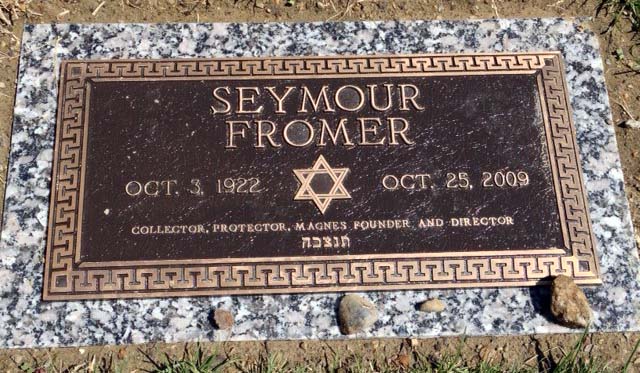
Collector, Protector, Magnes Founder and Director
I thought about what to say for all these long years—and now the deed is done. He's firmly fixed down under there. It's inescapable.
It wasn't just artifacts and manuscripts that he protected, although that's what he was known for. No, what he protected most of all was me. Seems more to the point than 'beloved father.'
And she's got closure too. I think she'd like what I finally came up with:

Teacher, Writer, Human Rights Fighter
These are the things that made her proud. Especially the 'fighter' part. Which is the part I always thought was unnecessary. But, well, whatever.
The point being—it finally does feel like closure. It really does. And she resisted it for so long when she was alive. Or maybe it was her anger he was gone. She herself had to wait one year as well—but that's expected. Within reason. He, on the other hand, was stoneless for four years.
I could feel him hovering, exploring, looking out for Judaica in the wee unlikely corners of the world. He was still out there on the hunt and prowl. And now, it's strange, he's not. Closure. He's happily ensconced. Just wishing that I'd bring him a pastrami sandwich from Saul's, heavy on the deli mustard.
They're in there. They're down there. They're under ground. They're quiet. Too quiet! Here's me. Up here. Still wanting to do them proud. Funny, I think about that now—making them proud—I never did before. Before. When they were alive, I did as I pleased. Studied what I wanted. Specialized in the not-usness that marks my chosen profession. But well, reprise: whatever. They like what I'm up to now.
Here's the weird thing. With closure, I seem to be able to write again. Though still the words are jerky, stiff and awkward. They don't flow. Watch them stumble across the line, almost embarrassed to take their places inside these clunky sentences. Oh well. At least it's writing. One word after another. A little rusty, sure. But real live actual words!
Is that what 'closure' does? Help us stumble on.
We wake up. And stretch. Clean the blech out of our eyes. Check ourselves out: Hmm. No broken bones, although the heart still aches. Is that what closure brings: Return to the land of the doing? Have we learned something yet? Are we a better person?
If so, I mean, well, this is America: Shouldn't there be a machine (or magic pill) that could do all this mourning for us quick and dirty? Help get us to the lessons of the closure side a helluva lot faster? Skip all that grief and pain, and go directly to 'just carry on'?
Or if no machine or pill has been invented, let's use the BigMac model. After all, we like to eat more than we like to labor.
I'll have my fries dipped in mourning sensitivity, (just not too much). A sprinkle empathy and sympathy, but only just a pinch. Gobble fast, greasy, and most of all, unthinking. Fast food for the bereaved. And then, you know, just let us rest in peace.
Will that work?
Monday, April 1, 2013
oba and oya have it out
I've never talked about Oba, not in public anyway. More, I whisper about her. Whisper to her. Whisper around her. Anything might offend. I try not to think about her too much. Living with her can be pure hell. But only sometimes. Here's the problem: her self-defeatism, if that is a word.
We had a conversation yesterday, 'conversation' being the polite word for it. She fucking cried, pouted, complained, and blamed (everybody else). Again.
"I'm all alone," she wailed, like I'm not right there next to her, as usual.
She then went on—you know the drill—nobody's helping her. Nobody's supporting her. Where's hers? I've heard this all before. Nobody's giving her a break, how 'bout a grant maybe, a really good job where you don't have to work. How 'bout free rent? Or no rent at all. How 'bout sex? Where's mine?
She cut off her ear, they say, to feed it to Chango.
You know, I just don't have much sympathy.
Oba could use a really good therapist, as far as I'm concerned.
She counters saying I don't understand her. Don't understand her pain. Her sense of humor. Her struggles. Her ambitions. How-hard-it-all-is for her in this world. She's absolutely right. She struggles like mad, and everything's a struggle. 'The world' just isn't taking care of her, and she's furious about that.
She's got to do it herself, and that just pisses her off. And she's sick of people telling her to pull herself up by the bootstraps and do it the fuck herself.
She raises her voice. She yells when she's not being just plain morose. She cut off her ear and fed it to Chango. (I mean, it didn't work too well for van Gogh either as a coping mechanism, but hell, at least he didn't stop painting).
Do you think that kind of behavior makes her more attractive? Do you think Chango was moved?
I'm not much of a supporter of woe-is-me strategies. I grew up hearing them, and I must say all it did was harden my soul. Make me want to never ever ask anyone for anything. Not long for anyone. And certainly not pine for them. I have no sense of 'deserving' or 'undeserving'. No sense of entitlement at all.
Expect nothing.
Be ready for anything.
Be prepared.
Maybe I'm a Boy Scout at heart.
It's not like Oba needs to pick up a sword to make her point. Granted, that's not her way. Just pick herself up. Dust herself off. Hold her head high. And get goddamn to work.
See what she's done? She's got me the fuck swearing.
Maybe I've got way too much of Weber's Protestant Ethic in me and not enough of Mauss's prestations. Or maybe I'm too selective in my sense of reciprocal obligations. Maybe I'm just a bitch with a sword. Maybe I'm supposed to fix her tight little universe for her. Find her a Chango and hand it to her on an ebony platter. Cut off my own ears and feed them to her so she can see I'm listening?
A good therapist is what she needs.
Maybe I should give her mine.
We had a conversation yesterday, 'conversation' being the polite word for it. She fucking cried, pouted, complained, and blamed (everybody else). Again.
"I'm all alone," she wailed, like I'm not right there next to her, as usual.
She then went on—you know the drill—nobody's helping her. Nobody's supporting her. Where's hers? I've heard this all before. Nobody's giving her a break, how 'bout a grant maybe, a really good job where you don't have to work. How 'bout free rent? Or no rent at all. How 'bout sex? Where's mine?
She cut off her ear, they say, to feed it to Chango.
You know, I just don't have much sympathy.
Oba could use a really good therapist, as far as I'm concerned.
She counters saying I don't understand her. Don't understand her pain. Her sense of humor. Her struggles. Her ambitions. How-hard-it-all-is for her in this world. She's absolutely right. She struggles like mad, and everything's a struggle. 'The world' just isn't taking care of her, and she's furious about that.
She's got to do it herself, and that just pisses her off. And she's sick of people telling her to pull herself up by the bootstraps and do it the fuck herself.
She raises her voice. She yells when she's not being just plain morose. She cut off her ear and fed it to Chango. (I mean, it didn't work too well for van Gogh either as a coping mechanism, but hell, at least he didn't stop painting).
Do you think that kind of behavior makes her more attractive? Do you think Chango was moved?
I'm not much of a supporter of woe-is-me strategies. I grew up hearing them, and I must say all it did was harden my soul. Make me want to never ever ask anyone for anything. Not long for anyone. And certainly not pine for them. I have no sense of 'deserving' or 'undeserving'. No sense of entitlement at all.
Expect nothing.
Be ready for anything.
Be prepared.
Maybe I'm a Boy Scout at heart.
It's not like Oba needs to pick up a sword to make her point. Granted, that's not her way. Just pick herself up. Dust herself off. Hold her head high. And get goddamn to work.
See what she's done? She's got me the fuck swearing.
Maybe I've got way too much of Weber's Protestant Ethic in me and not enough of Mauss's prestations. Or maybe I'm too selective in my sense of reciprocal obligations. Maybe I'm just a bitch with a sword. Maybe I'm supposed to fix her tight little universe for her. Find her a Chango and hand it to her on an ebony platter. Cut off my own ears and feed them to her so she can see I'm listening?
A good therapist is what she needs.
Maybe I should give her mine.
Monday, November 5, 2012
meetings with remarkable men
Actually, what I was after was a meeting with just one remarkable man. I had questions. He had answers. Not answers in the usual way, but he could expound, he could encourage. He could inspire. Influence. I could be bathed in his charisma. Be brought to tears by his wisdom. Stand in awe... Sit at his feet... You know the drill. Just your usual meetings with remarkable men.
I do have a rebbe who inspires in this way. And I heard him speak recently at a week long workshop at the Islamic Center in Oakland, California. Yup, he's that inspiring. You heard me right. The Islamic Center. This is what makes him so inspiring. The rabbi at the Islamic Center. It was also his birthday. He was turning 88.
He was more frail than I had ever seen him. He was aided by a tall Shaikh with an exotic name. There was even a zikhr in my rebbe's honor—an Islamic (Sufi, really) shared invocation of the Divine Name that can bring participants to trance, or tears, from the beauteous repetition of the holy name. For me, it brought me to both. Trance and tears. To be in the presence of this remarkable man. To think that I might not see him ever again. To realize that the zikhr still holds so much power over me. And in the flickering contemplation at the back of my mind (or perhaps my heart) of the long-felt secret desire to convert to Islam, if only for the purifying effect of the zikhr.
But the power of my rebbe was such, that there was no need for conversion. My rebbe himself practices zikhr. He himself is a Shaikh. A Sufi master. He practices something he calls multireligiousity, and advocates it mightily. Why limit yourself when there's so much out there in traditions not your own? I'm pretty ambivalent about such a position. My Native American friends think it's dangerous horseshit. And they're pretty vocal about it.
But the argument is valid. Why should we be limited by the narrowness of our own natal traditions, when others are so (or equally) powerful?
My rebbe's not talking about appreciation-of-the-Other. Not talking about acceptance or tolerance. Or visiting each other's holy places and houses of worship. Not talking about broad-based scholarship. Not talking about fieldwork among. No. He's talking about practice. About becoming. And holding all of it (yours, his, mine), holding all of it in the same thimble. Drinking all of the medicine down. Becoming. Being. Experiencing.
My little rebbe and the tall shaikh are on the same page in this regard. You should have heard the shaikh's yiddishisms! A miracle, indeed.
But that's not quite what I wanted to say here. What has brought me out of my long silence, after the death of my mother. Strange how her death brought me to a virtual paralysis of the fingertips. For almost a year, I have hardly been able to write a word. Strong mojo, that woman. I still don't understand it. I had so much to say, and it was just washed away in the shock of her departure.
No, what brought me back to my keyboard was waking up to a dream this morning. And thinking that it was still happening. That I was still there. It was one of those dreams. Hyper-real. How could it not have happened? It clobbered me. It shook me up. Wagged its finger at me in admonishment. It taught me a lesson. I'll show you, it said. You know. The usual dream stuff.
I needed to see Reb Zalman. I needed to confer with him about something urgent. It had to do with the Biblical Hebrew word את in the first lines of Genesis. It had to do with an important point in the film I'm making. Reb Zalman Schachter-Shalomi had been too frail and exhausted to meet with the many of us who had wanted individual consultations at the workshop. And I don't blame him. It's the nature of remarkable men that we pull at them, that we want their baraka (or their bracha)... We followers must be an exhausting lot. But he nodded graciously at me, his acknowledgement. A little twinkle in his eye. That in itself was precious, he was that holy in my mind.
But in the dream, I was given access. Here's the time. Here's the place. Here's the room number.
I took the elevator up to the 7th floor, and looked around. The Organization up there was all in the service of the rebbe. I was definitely in the right place, and so I wandered around. Read the literature. Waited. I'd come early, of course, hoping for more time. My questions were just that urgent.
After waiting my fair share, I went up to the Reception because I couldn't find the room.
"You're on the wrong floor," the neo-frummish woman told me. "He's in Room 6.1, which is not on 7."
I had gone to the wrong floor. Written the wrong number. Was in the wrong place. Was going to be late for my coveted and hard-won meeting.
I wasn't worthy, after all.
The elevator didn't stop on the 6th floor. That was a floor that required special access, and I seemed to have lost my privileges. The elevator no longer worked for me, although it would have earlier apparently.
I took the stairs.
The stairway door was miraculously slightly ajar. I was on the 6th floor at last.
And there, as I walked the hallway looking for 6.1—I saw every door somewhat ajar. And in every room sat a holy man or holy woman. Every different color. Bearded and unbearded. Gray haired and dark hair. Turbaned and veiled and uncovered. All. Waiting. Every door was open, every saint or shaikh or rebbe, every lama, every monk. Every insurgent rebel. Every learned practitioner. Every intuitive. Every tzaddik. Waiting there. All I had to do was walk through any door. Or all of them.
All, save 6.1. That one wasn't there at all.
I woke up this morning to a time change. I'm still not quite awake, really. Did time move forward or did it move backward? Or maybe it stopped entirely, and I don't have to teach my class. And what would I teach them, anyway?
There's this door, and there's that door I suppose. And, okay, yes—they're all more or less open. And what's strangest of all—is that my students most definitely walk through mine.
I do have a rebbe who inspires in this way. And I heard him speak recently at a week long workshop at the Islamic Center in Oakland, California. Yup, he's that inspiring. You heard me right. The Islamic Center. This is what makes him so inspiring. The rabbi at the Islamic Center. It was also his birthday. He was turning 88.
He was more frail than I had ever seen him. He was aided by a tall Shaikh with an exotic name. There was even a zikhr in my rebbe's honor—an Islamic (Sufi, really) shared invocation of the Divine Name that can bring participants to trance, or tears, from the beauteous repetition of the holy name. For me, it brought me to both. Trance and tears. To be in the presence of this remarkable man. To think that I might not see him ever again. To realize that the zikhr still holds so much power over me. And in the flickering contemplation at the back of my mind (or perhaps my heart) of the long-felt secret desire to convert to Islam, if only for the purifying effect of the zikhr.
But the power of my rebbe was such, that there was no need for conversion. My rebbe himself practices zikhr. He himself is a Shaikh. A Sufi master. He practices something he calls multireligiousity, and advocates it mightily. Why limit yourself when there's so much out there in traditions not your own? I'm pretty ambivalent about such a position. My Native American friends think it's dangerous horseshit. And they're pretty vocal about it.
But the argument is valid. Why should we be limited by the narrowness of our own natal traditions, when others are so (or equally) powerful?
My rebbe's not talking about appreciation-of-the-Other. Not talking about acceptance or tolerance. Or visiting each other's holy places and houses of worship. Not talking about broad-based scholarship. Not talking about fieldwork among. No. He's talking about practice. About becoming. And holding all of it (yours, his, mine), holding all of it in the same thimble. Drinking all of the medicine down. Becoming. Being. Experiencing.
My little rebbe and the tall shaikh are on the same page in this regard. You should have heard the shaikh's yiddishisms! A miracle, indeed.
But that's not quite what I wanted to say here. What has brought me out of my long silence, after the death of my mother. Strange how her death brought me to a virtual paralysis of the fingertips. For almost a year, I have hardly been able to write a word. Strong mojo, that woman. I still don't understand it. I had so much to say, and it was just washed away in the shock of her departure.
No, what brought me back to my keyboard was waking up to a dream this morning. And thinking that it was still happening. That I was still there. It was one of those dreams. Hyper-real. How could it not have happened? It clobbered me. It shook me up. Wagged its finger at me in admonishment. It taught me a lesson. I'll show you, it said. You know. The usual dream stuff.
I needed to see Reb Zalman. I needed to confer with him about something urgent. It had to do with the Biblical Hebrew word את in the first lines of Genesis. It had to do with an important point in the film I'm making. Reb Zalman Schachter-Shalomi had been too frail and exhausted to meet with the many of us who had wanted individual consultations at the workshop. And I don't blame him. It's the nature of remarkable men that we pull at them, that we want their baraka (or their bracha)... We followers must be an exhausting lot. But he nodded graciously at me, his acknowledgement. A little twinkle in his eye. That in itself was precious, he was that holy in my mind.
But in the dream, I was given access. Here's the time. Here's the place. Here's the room number.
I took the elevator up to the 7th floor, and looked around. The Organization up there was all in the service of the rebbe. I was definitely in the right place, and so I wandered around. Read the literature. Waited. I'd come early, of course, hoping for more time. My questions were just that urgent.
After waiting my fair share, I went up to the Reception because I couldn't find the room.
"You're on the wrong floor," the neo-frummish woman told me. "He's in Room 6.1, which is not on 7."
I had gone to the wrong floor. Written the wrong number. Was in the wrong place. Was going to be late for my coveted and hard-won meeting.
I wasn't worthy, after all.
The elevator didn't stop on the 6th floor. That was a floor that required special access, and I seemed to have lost my privileges. The elevator no longer worked for me, although it would have earlier apparently.
I took the stairs.
The stairway door was miraculously slightly ajar. I was on the 6th floor at last.
And there, as I walked the hallway looking for 6.1—I saw every door somewhat ajar. And in every room sat a holy man or holy woman. Every different color. Bearded and unbearded. Gray haired and dark hair. Turbaned and veiled and uncovered. All. Waiting. Every door was open, every saint or shaikh or rebbe, every lama, every monk. Every insurgent rebel. Every learned practitioner. Every intuitive. Every tzaddik. Waiting there. All I had to do was walk through any door. Or all of them.
All, save 6.1. That one wasn't there at all.
I woke up this morning to a time change. I'm still not quite awake, really. Did time move forward or did it move backward? Or maybe it stopped entirely, and I don't have to teach my class. And what would I teach them, anyway?
There's this door, and there's that door I suppose. And, okay, yes—they're all more or less open. And what's strangest of all—is that my students most definitely walk through mine.
Thursday, August 23, 2012
multireligiosity
Okay. I learned a new word. And I'm not sure what I think about it. In the past I've been downright incensed at the theft of indigenous spiritual practices by white wannabes. True, my outrage is for the most part borrowed. My indigenous friends just about foam at the mouth over this one. Especially when the appropriated song or ritual or practice is used by the wannabe at the wrong time, at the wrong place, and for the wrong purpose.
How can you, they inquire, take my song and abuse it this way? You took our land and our language. You stole our children and shipped them off to Christian boarding schools —and now you want our spirituality? Spiritual theft, indeed. I get it.
Remember the Cherokee elders who heckled Felicitas Goodman one year when we were all in Tempe, "The Creator made you a Presbyterian," they shouted. "Go back to church!"
My indigenous friends make the case for pure systems. Or for trying to keep them as pure as possible given that these 'systems' are by now long ago polluted with otherness, or almost completely wiped out anyway.
I understand the indigenous complaint. I'm sensitive to it. My own people are practically extinct as well. And I'd like to say that I don't beg, borrow, or steal from the traditions of others. Surely I don't practice anyone else's religion. I mean, I barely practice my own. No wonder it's dying out. So there should be nothing to complain about on that front. And I've learned to be super careful about not inviting guest lecturers to speak in my classes if they're folk who are immersed in someone else's tradition, no matter how knowledgeable or devout or sincere they may appear.
But then there's Zalman. Reb Zalman Schachter-Shalomi, my mentor. Reb Zalman, whose teachings helped me reconcile my love for Islamic cultures with holding on to my own unshakeable (nearly extinct) Sephardi identity. I had it all worked out at one point: I mean after all, it's because of the Ottoman Islamic State that my people survived at all. And before that, we thrived in Islamic Spain. It all sounds so rational when you put it like that. I mean, it's not like I wear a hijab (though I think they're pretty elegant), and I certainly don't perform Islamic prayers five times a day. No. I just appreciate Islam. It makes a lot of sense to me.
I hadn't seen Reb Zalman in many, many years, but here he was, giving a symposium for Star King at the Islamic Cultural Center in Oakland. Three days of Zalman!
And the service had everything in it.
Just name a religion, and it's tradition was in there somewhere. No pygmy chants that I recognized, but you get my point.
The word of the day was 'multireligiosity' —and the Star King folk, they practice what they preach. And it was pretty stunning. Each sentence was peppered with the weaving together of traditions. And so were the songs that were sung, and the gestures, and the clothing.
I want to call it syncretism, but it isn't. It's something more personal that that. For it seemed that every person in the hall had a different combination of religious affinities. And the lectures and sermons encouraged more of the same.
And to tell the truth, it was pretty neat to hear the Jewishisms coming out of the mouths of Muslims, and the Islamicisms falling out of the mouths of Jews. It wasn't forced, or enforced—it was merely comfort and familiarity with the Other. Or, no, not that—for Otherness had disappeared from their vocabulary. It was fairly seamless.
Reb Zalman spoke of the virtues of being in-between the strict adherences of the isms. He encouraged all to cultivate the larger tapestry. What kind of religion serves best the healing of the planet? Go and practice that.
It was three days of religious liminality. But it wasn't just about appreciating the Other, it was about practicing the practices of each. The symposium wasn't just merged wordings—there was ritual too. Performativity. And this is something I'm profoundly uncomfortable with. But Zalman encourages participation (and sure, it's part of anthropological methodology as well) (and so, deciding to be a good sport, and put my bloody notebook down and stop taking notes) I found myself in —
zikr
—crying my eyes out, as we chanted and bobbed. The rhythm is exactly the type that moves me, or maybe moves everybody. Look at films of zikr and you'll see just how entrancing it is. And it made me feel instead of making me think. Which is exactly what it's supposed to do. And exactly what Reb Zalman wants me to do. After all, he's a Jewfi.
Two zikrs in three days can bring on an addiction for sure. It's precisely the practice of religious ritual that is so powerful, not the intellectual appreciation of it. I'm still going to chalk it up to participant-observation, this time, at least. But deep down, I'm not so sure. I believe I'm in grave danger of wanting more.
And maybe of going out and finding it.
How can you, they inquire, take my song and abuse it this way? You took our land and our language. You stole our children and shipped them off to Christian boarding schools —and now you want our spirituality? Spiritual theft, indeed. I get it.
Remember the Cherokee elders who heckled Felicitas Goodman one year when we were all in Tempe, "The Creator made you a Presbyterian," they shouted. "Go back to church!"
My indigenous friends make the case for pure systems. Or for trying to keep them as pure as possible given that these 'systems' are by now long ago polluted with otherness, or almost completely wiped out anyway.
I understand the indigenous complaint. I'm sensitive to it. My own people are practically extinct as well. And I'd like to say that I don't beg, borrow, or steal from the traditions of others. Surely I don't practice anyone else's religion. I mean, I barely practice my own. No wonder it's dying out. So there should be nothing to complain about on that front. And I've learned to be super careful about not inviting guest lecturers to speak in my classes if they're folk who are immersed in someone else's tradition, no matter how knowledgeable or devout or sincere they may appear.
But then there's Zalman. Reb Zalman Schachter-Shalomi, my mentor. Reb Zalman, whose teachings helped me reconcile my love for Islamic cultures with holding on to my own unshakeable (nearly extinct) Sephardi identity. I had it all worked out at one point: I mean after all, it's because of the Ottoman Islamic State that my people survived at all. And before that, we thrived in Islamic Spain. It all sounds so rational when you put it like that. I mean, it's not like I wear a hijab (though I think they're pretty elegant), and I certainly don't perform Islamic prayers five times a day. No. I just appreciate Islam. It makes a lot of sense to me.
I hadn't seen Reb Zalman in many, many years, but here he was, giving a symposium for Star King at the Islamic Cultural Center in Oakland. Three days of Zalman!
And the service had everything in it.
Just name a religion, and it's tradition was in there somewhere. No pygmy chants that I recognized, but you get my point.
The word of the day was 'multireligiosity' —and the Star King folk, they practice what they preach. And it was pretty stunning. Each sentence was peppered with the weaving together of traditions. And so were the songs that were sung, and the gestures, and the clothing.
I want to call it syncretism, but it isn't. It's something more personal that that. For it seemed that every person in the hall had a different combination of religious affinities. And the lectures and sermons encouraged more of the same.
And to tell the truth, it was pretty neat to hear the Jewishisms coming out of the mouths of Muslims, and the Islamicisms falling out of the mouths of Jews. It wasn't forced, or enforced—it was merely comfort and familiarity with the Other. Or, no, not that—for Otherness had disappeared from their vocabulary. It was fairly seamless.
Reb Zalman spoke of the virtues of being in-between the strict adherences of the isms. He encouraged all to cultivate the larger tapestry. What kind of religion serves best the healing of the planet? Go and practice that.
It was three days of religious liminality. But it wasn't just about appreciating the Other, it was about practicing the practices of each. The symposium wasn't just merged wordings—there was ritual too. Performativity. And this is something I'm profoundly uncomfortable with. But Zalman encourages participation (and sure, it's part of anthropological methodology as well) (and so, deciding to be a good sport, and put my bloody notebook down and stop taking notes) I found myself in —
zikr
—crying my eyes out, as we chanted and bobbed. The rhythm is exactly the type that moves me, or maybe moves everybody. Look at films of zikr and you'll see just how entrancing it is. And it made me feel instead of making me think. Which is exactly what it's supposed to do. And exactly what Reb Zalman wants me to do. After all, he's a Jewfi.
Two zikrs in three days can bring on an addiction for sure. It's precisely the practice of religious ritual that is so powerful, not the intellectual appreciation of it. I'm still going to chalk it up to participant-observation, this time, at least. But deep down, I'm not so sure. I believe I'm in grave danger of wanting more.
And maybe of going out and finding it.
Monday, August 13, 2012
writing and seduction
"Have you written anything for me lately?"
School is starting in a week or two—and for the first time in my sentient life I won't be there to greet it. For me, school is finally, finally over.
But life is not as much fun without a little seduction now and then. Time to pick up that quill again, and try my rusty hand.
Well, no. Nothing at all.
So. What's the problem? And actually, I want to solve here a larger problem. The problem of bad writing altogether, especially that of undergrads. And maybe a few grad students as well. Or. To be honest. Maybe a lot of grad students.
And then I'll solve the teaching problem too. But not till the end of the post. Or next post, if I don't get around to it. But I think I will.
No. I haven't written anything for you lately. I've been too busy sleeping with you. Camping with you. Doing the being-together thing with you. I haven't written a goddamned word. Cooking. Doing the laundry. Emptying the trash. Muzzling the barky dog. Unmuzzling the quiet dog. Setting up the new computer to start writing. Clearing off the desk. Picking up the dogs shit. Working out, for god's sake!
Anything, anything at all but writing.
Which spells for me a stage of life that might be called 'post-seduction.'
It's that easy (still early enough) part of a relationship in which just picking up someone else's dog's shit is still kinda a kick enough to be fun. And done out of love and reciprocity (I pick up your dog shit, you pick up mine), and has not descended into resentment, or even worse—rage. Horrors. Don't get me wrong: it doesn't ever need to go that way. I think I like this stage of post-seduction. I like the mutuality of it. The minutiae of it. It's pretty easy. But I'm not sure it's quite enough.
Because writing is a powerful seduction.
I don't mean the kind of writing written explicitly in order to make a million bucks or two. I don't mean strategic writing. The porn of how he gets laid every X number of pages because you think that sells. That's not seduction. That's ambition. And I'm not talking about ambition.
The Story of O didn't make those big bucks because it was trying to seduce a large well-paying audience. Anne Desclos (Pauline Réage) had only an audience of one in mind. Everyone else has been just eavesdropping on a very private conversation.
And that's why it works.
And that's why it works.
The best writing has a sense of urgency as well as a very clear sense of audience.
Desclos knew what she was doing. As did Genet, when he sat in prison pleasuring himself with words. The stuff just pours out (the words, I mean—though with Genet, that would be both), because there's no way to dam the flow. Compelling writing is like that. And it doesn't have to reach everybody. It just has to reach that one person. The eavesdroppers come along for the ride. They're a freebie, if you will.
Desclos knew what she was doing. As did Genet, when he sat in prison pleasuring himself with words. The stuff just pours out (the words, I mean—though with Genet, that would be both), because there's no way to dam the flow. Compelling writing is like that. And it doesn't have to reach everybody. It just has to reach that one person. The eavesdroppers come along for the ride. They're a freebie, if you will.
Undergrads primarily write out of obligation. Coercion.
"How many pages do you want?" they ask in dismay.
They're not all like OMG, can you believe it, I GET to write something... I am so jazzed...
Think about it, students (if I may address you as such, just for a moment, one last time). When school is finally over, it is very likely that no one will ever give you the opportunity to take the time and just pour out your words ever again. For some of you, it's very likely you'll never ever write again. At least, that's what you've told me.
And you've forgotten, it seems, that someone has to read this crap you've flung at us as pages filled. Student papers have to be read (unlike that porn, the NYT, or any other written word). Someone has to read them. And that someone used to be me. But no, no more. With luck, I will never read another student paper ever again.
So. I'm gonna say this straight out (and with all due respect)—and I hope it helps. And maybe I should have said it in class. But no, you'd have taken it all wrong—
The best papers are a seduction.
They're written with words put together with that one specific 'audience' in mind. Beautiful combinations of words. Just for me, for you, whomever. A topic filled with three parts desire for every part called eloquent. Seduction trumps eloquence any day.
They're written with words put together with that one specific 'audience' in mind. Beautiful combinations of words. Just for me, for you, whomever. A topic filled with three parts desire for every part called eloquent. Seduction trumps eloquence any day.
It doesn't matter what the topic is.
Write about-the-economy-stupid. Write about Romney. Saddam (curious unconscious transition there). Write about whether to fund (or weaponize) Syrian rebels. Or how to get your name on a crater of Mars. Write about daffodils in the very early springtime. Drought mid-summer. What you had for breakfast this morning (and why we should care). Write about the gods. It's never ever about the subject anyway.
But if you're writing for that goddamned grade (or to make you that fortune you think is there)—you've missed the mark. You've got to be turned on by your own writing.
Seduce yourself, first and foremost, no matter the topic.
There's a flush, a blush in those students who fall in love with their own work. Their cheeks blossom, their eyes twinkle. They're not being strategic, they're being excited by the material at hand.
I haven't written for you lately.
I've been too busy doing anything but writing.
Because my own writings were missives to death, love songs to the dead and dying. Remembrances, lest I forget. Tales to my children, lest they never have the opportunity to remember. Stories that will be forever gone if I don't write them down. No one else can do it.
In the face of death and dying, I seduce myself with words. Genet was ever my best teacher.
Ah, but here's the rub. Let me not put this all upon the student who writes because he feels he's forced. Because the-system's telling him to jump through hoops, crank out those pages. Because he's stuck with an English class (or god-forbid, Anthropology) and he's an Engineering student. And shit, I have to in order to-get-outta-here. Goddamn it, when they resent their being in school, it drives me mad!
This goes for teachers, too, you know.
This goes for teachers, too, you know.
Teaching is seduction, too.
A prominent psychoanalyst told me that one time when I complained to him of such.
Not a seduction of the person, but of the material at hand. If you as you lecture are in love with your topic, that is the best seduction of all. (In truth, that's not quite what he said. To an analyst, it's all about the person).
Topic doesn't matter. Ancient Greek or Pleistocene dentition. The fall of the Ottoman Empire. Black holes. Who cares? It's all seduction-worthy.
Blow on those embers and makes them glow.
I've been doing laundry, not writing. Cooking for you. And eating your own exotic meals. Camping out, and hiking trails. Studying pig roasts and fishin' holes. Walking dogs and bagging dog shit together. I've been doing chop wood, carry water of late. Pouring out a simple kind of love and not seduction.
In other words, I started just to live again. And started leaving all those stories far behind.
School is starting in a week or two—and for the first time in my sentient life I won't be there to greet it. For me, school is finally, finally over.
But life is not as much fun without a little seduction now and then. Time to pick up that quill again, and try my rusty hand.
Subscribe to:
Posts (Atom)
