So. I'm reading this passage for Zohar class.
That should be enough right there, really. Reading Zohar, the ' I ' disappears. And so does the passage. And Zohar. And class. They're all just gone.
And all that's left are these levels. They're not the levels from pshat (simple and concrete) to sod (the hidden and ineffable). No—they're the levels that start with—well, Joseph. Joseph dreaming. So. Level 1, we're inside Genesis with him, hearing his (somewhat woeful) tale. And I'm wondering if Joseph invented the movie arc, because he sure thrives on drama. Then again, what is biblical text if not the bad choices of one generation after another?
I don't like Joseph very much, although—give me enough evidence to the contrary and I'd be willing to reconsider. I find him self-absorbed and self-serving. A preening pretty-boy. Not too much on the ball—but yah, with survival skills and damned good intuition. And he's great at how to rub people exactly the wrong way. He's got that attraction/repulsion thing going on full force. For me—I'm fairly repulsed. Go ahead. Sell him to the Egyptians. See if I care.
Arthur Green calls Zohar 'sacred fantasy' —and then he builds on that. That sounds like Torah to me for starters. Zohar, I think, is a tale of dreamers dreaming together—building on the dreams of the past, and handing those dreams off to us, if we want them.
Level 2. That would be the Chevraya of Rabbi Hiyya and his buddies. Gathered around R' Shim'on ben Yohai. I picture all of them sitting around deep into the night, sipping the Turkish, smoking a little kif, and trying to figure it all out. Wandering around together having adventures—somewhere in-between Easy Rider and Zen and the Art of Motorcycle Maintenance. On the Road. Zohar is the original boys' buddy flick.
Like my dad, the Tzaddik, running off with the impulsive Rabbi K...
I grew up on the tales of the Tzaddik's wanderings across half the globe with his buddy, Rabbi K. Frightening adventures of keeping him out of trouble. Tales of eaten documents and stolen artifacts. Of charisma and misadventure. And then, before you knew it—I was old enough to go with them on their adventures. And then—suddenly, they were following me, on mine.
I have no business being jealous of R' Hiyya and his pals. He's got nothin' on me. But I am truly and deeply jealous. I mean, being an anthropologist is one great encounter after another, sure—in a universe where everything, everything is very good data. There's no truth, no falsehood. There's only perspective. And that's what I collect.
Still. It would be nice not to have to go it alone so much of the time.
So I dream of R' Hiyya dreaming of Joseph, and Joseph who's dreaming up a storm. I dream of my father and his love affair with adventure. My protector, the collector, the museum director. I'm in India with them. Or Egypt. I'm in Tunisia—finding the Maltese mermaid chanukkiyah for him. (That's me playing Bogart playing the garment of my dad). Finding—finding the Maltese mermaid
—for my father.
I'd do anything, anything at all for my father.
And now, we're on the Island of Djerba. And now, the Middle Atlas. And it's Paris. Tracking down some ancient enameled fibula made by Jewish jewelers in Tiznit on the edge of the desert. I'm a child, in the Mother Lode—and we're searching for cemeteries. Trying to find every last one of them...
Open your eyes. What was the passage again? I think I was dreaming.
And so it goes.
Level 3. We're in Castile, land of my ancestors. It's the 13th century outside. But then again, here in Toledo, it's always the 13th or 14th century outside. The tourists love it. They say we're sitting under a shade of a tree in a garden or a grove of trees. But I don't buy it. There are no groves of trees inside the walls of Toledo. Medieval cities just weren't made that way, and it's a long climb down from the walled city to the farmlands below the mountain town. But look: there's a secret room in the back of the Santa Maria, that used to be a synagogue. And there's a shady spot in the courtyard of the Muséo Sepharad, as well. Right there, under what once must have been a trailing jasmine. So that when the wind would blow, the air would be as sweet and drunken as boys deep inside the text.
And we're sitting there, and the breeze lifts. And a bird rises—
What was the passage again—?
Level 4. There are too many people. Or maybe it's just that I don't know most of them. And of those I know, we have a study group of our own. Study group inside study group inside... And there, we sit in the Library of Beit Malkhut, well into the night, and we let our dreams wander and meet.
But we have no Reb Shim'on. And no Moses de Leon to lead us. We wander. Often very far afield. We stumble. But we can bring the dreams.
And each of the chevra in our Zohar class has something penetrating to add. And if only we could follow each and every thread to form this garment. Ah! But I don't know where we're going, and I'm not sure where we've been. I've not journeyed with these people very long—they're heading somewhere down a narrow tunnel—and I am way outside.
Anthropologist. Can't get past the problem of context.
Joseph went to Egypt. And there he encountered Nuit and Geb. Nuit held up the sky so the stars would have some room to breathe. Geb kept the earth together in one piece, below. And souls would journey between the two—upper world, underworld, in circles of transmigration, in cycles of time—solving the problem of death. And Egyptian artists painted this vision, and even the common man could be comforted by the cycle they were part of.
But the heroes of Zohar are forbidden image making, except with their minds. And so they wave their hands about, trying to conjure up the journeys of their soul. They stitch garments in the air for their astral body. But those garments, they have no form, no matter, and no substance. They are tapestries woven of the heavens themselves.
In Egypt, they could see everywhere these icons and depictions. And that's what Joseph saw. They could see the vivid, vibrant colors of the passage of their souls. Ideas and abstractions took artistic form for all to see. Geb and Nuit—as clear as day and night. Here is a picture of time. Here is the journey of our soul. It's all quite clear.
The rabbis struggle, I believe, because they cannot paint. But no one has taken away their dreams.
And so, I dream. I dream of rabbis painting. And Joseph weaving a garment of his own. And the Levels—they collapse. Nuit holds up the heavens above. Geb supports the earth below. And in the middle Joseph, dreaming...
Is it blasphemy to want to paint a canvas instead of waving desperate fingers in the air?
Sorry, what page are we on?
Wednesday, December 2, 2015


Saturday, November 28, 2015
the tattoo moment that I apparently didn't tell you—for madison
This is supposed to start with a "and there I was, and—" sort of thing. There I was standing in this bookstore, of all places...
But the fact is, I've always gotten off on bookstores. And libraries. (But only really really good ones.) And I do so love the smell of musty books... and ink.
So I guess what happened may have been inevitable, and doesn't start with "and there I was—" at all. Because I was always there. Always.
So. If I say "when I was a kid my dad took me to Holmes Bookstore in San Francisco, and gave me a dollar—" —well, many stories would begin this way. And so, I have a history with bookstores. And, as I said, with libraries too. And, I'm afraid to say, I've had more than one peak and downright orgasmic moment in one or the other.
So. To start with "there I was—" becomes kind of silly, since I was, so much of the time, there. It was, I suppose bound to happen.
My official favorite bookstore in the world is Le Tiers Mythes, which is kind of behind the Sorbonne on the tiny Rue Cujas off the Boul Mich in Paris. I've been going to this bookstore every trip to Paris for decades.
And each trip, the bookshop keeper would take a look at me, reach up somewhere on the tottering shelves, and hand me something and say—"this is for you."
And my life would shift into a new pattern from that point until the next.
So. I was standing there. As always, in exactly the same spot I tend to go to. And in front of me was a reprint of a Revue Africaine from around 1885 and I was just holding it in my hands, not even open, when one of those moments emerged—
"What if—" I thought.
That's how the good moments start, isn't it?
I remember exactly what that moment felt like. One of those moments when everything just clicks into place, even if no one else on the planet gives a shit.
"What if North African tattoo patterns were really a lost ancient writing system of the Amazigh people?"
Yah, it's one of those kind of bookshops. Highly specialized for those interested in the legacy of French colonialism throughout the world, but particularly in the Middle East and especially North Africa. And feminisms of the so-called Third World. Revolutionary figures from same. Thus the name: 'Le Tiers Mythes' — but this was an esoteric moment even for there.
The bookseller went down the ladder into the dark bowels of storage, and came out with a stack of century old journals and reprints of same. And clunked them down in front of me.
I started collecting as many Revue Africaine reprints from that period as I could. There were a series of articles by a Capitaine Rinn on the origins of Tifinagh, the writing system of the Berber (Amazigh) language, Tamazight. Rinn took an approach completely different from any study of a writing system I'd ever seen before.
And I did what any impressionable anthropologist of a certain age would do: I wrote a little grant proposal to study the possibility of studying the problem.
The idea was (as far fetched as it might sound) to drive down into the Sahara to the oldest Library in North Africa to look for documents that might link the images in tattoo patterns to the ancient tifinagh script.
First stop was Casa, to meet with a local professor who I'd heard was interested in the tifinagh problem. This was Day One of our expedition to the the Sahara. Luckily, I'd brought my Michelin map of Morocco with me to the professor's house.
"I thought so too," he said. "So I went down there. And your vehicle, by the way, you would never have made it that deep into the desert. Jamais."
My grant didn't cover an expedition-worthy vehicle. I did, however, have a clunker. I hadn't really thought 'methodology' through, I was so caught up in this ridiculous proposition.
"There's nothing there," he said.
Everything in the ancient Library had been stolen or 'redistributed' long ago. It had long ago been emptied of its treasures.
"But anyway, for what you are after, that's not the right place," he said, as if this were an Indiana Jones movie and I was digging in the wrong place.
He took my map and drew a big circle on it surrounding an entirely different territory.
"That's where you will find what you are looking for," he said. We finished our tea, I thanked him, and left.
It feels like fraud.
You know—when you write a proposal for one kind of research only to discover that your premise (and therefore your entire methodology) is entirely just plain wrong. Day One of this project, and I had to rethink the entire enterprise.
Drove back to where we were staying. The house of a friend of a friend of a friend. Where, too, were other friends of friends crashed out on cushions on the floor.
When I came back looking so despondent, my host gave me that look and asked what could possibly have gone wrong before I'd even started my expedition.
I pointed to the map. One finger trying to account for the entire region of the Middle Atlas Mountains to where I was now being redirected.
"My grandmother lives right there," one of the friends of friends of host said. "And she's got tattoos like you're looking for. And we're going there tomorrow to celebrate Eïd. And you are welcome to come and join us."
His grandmother lived right there—exactly where my random pointed finger had indicated the vastness of the entire mountain range. And so, right then and there the new direction of my inquiry took (re)direction.
Years later, and many grandmother's tattoos later—I found myself in the valley before a fortress village way south and deep in the High Atlas Mountains. The valley and steep mountain sides on either side of the river looked uncannily familiar.
And I glanced at my tattooed hands.
The tattoo on my left hand suddenly appeared to be a map. Not a treasure map, but a map of this very valley. And with the help of Capitaine Rinn's articles from the 1880s and beyond, I was able to decipher it.
On my hand was a stylized river surrounded by two mountains just like what was right in front of me. With Amazigh tents on each side—little triangles inside the larger triangles. And on my hand was (using Rinn to decipher it) at the peak of each triangle was the symbol for a matriarch gathering her sons about her.
A call to arms.
And that's what we found. The height of a movement for Amazigh language revival. You could tell by the spray painted graffiti on the mountain walls. A call to arms (without the arms) before it's too late. A call, it turned out, to preserve tifinagh and the Amazigh language, Tamazight before it disappeared entirely in the next generation.
And was there a connection between Amazigh tattoo patterns and tifinagh, the ancient writing systems? Undoubtedly. But the women of the High Atlas did not know of it.
"It's forbidden," they said.
No more tattoos. No more tifinagh.
All that was left were the patterns.
And the women diligently put the patterns into their rugs. And into their pottery. And the men put the patterns into their architecture.
"It's just decoration," the women insisted.
"Folklore," the men said with a smile.
"We speak Arabic now," they said in not-quite Arabic.
"You can take pictures," they said. "We love tourists."
"But you cannot ask questions."
"Or write anything down."
"Writing will get us arrested."
And they put their fingers to their mouths, to shush me.
And I took pictures.
But the fact is, I've always gotten off on bookstores. And libraries. (But only really really good ones.) And I do so love the smell of musty books... and ink.
So I guess what happened may have been inevitable, and doesn't start with "and there I was—" at all. Because I was always there. Always.
So. If I say "when I was a kid my dad took me to Holmes Bookstore in San Francisco, and gave me a dollar—" —well, many stories would begin this way. And so, I have a history with bookstores. And, as I said, with libraries too. And, I'm afraid to say, I've had more than one peak and downright orgasmic moment in one or the other.
So. To start with "there I was—" becomes kind of silly, since I was, so much of the time, there. It was, I suppose bound to happen.
My official favorite bookstore in the world is Le Tiers Mythes, which is kind of behind the Sorbonne on the tiny Rue Cujas off the Boul Mich in Paris. I've been going to this bookstore every trip to Paris for decades.
And each trip, the bookshop keeper would take a look at me, reach up somewhere on the tottering shelves, and hand me something and say—"this is for you."
And my life would shift into a new pattern from that point until the next.
So. I was standing there. As always, in exactly the same spot I tend to go to. And in front of me was a reprint of a Revue Africaine from around 1885 and I was just holding it in my hands, not even open, when one of those moments emerged—
"What if—" I thought.
That's how the good moments start, isn't it?
I remember exactly what that moment felt like. One of those moments when everything just clicks into place, even if no one else on the planet gives a shit.
"What if North African tattoo patterns were really a lost ancient writing system of the Amazigh people?"
Yah, it's one of those kind of bookshops. Highly specialized for those interested in the legacy of French colonialism throughout the world, but particularly in the Middle East and especially North Africa. And feminisms of the so-called Third World. Revolutionary figures from same. Thus the name: 'Le Tiers Mythes' — but this was an esoteric moment even for there.
The bookseller went down the ladder into the dark bowels of storage, and came out with a stack of century old journals and reprints of same. And clunked them down in front of me.
I started collecting as many Revue Africaine reprints from that period as I could. There were a series of articles by a Capitaine Rinn on the origins of Tifinagh, the writing system of the Berber (Amazigh) language, Tamazight. Rinn took an approach completely different from any study of a writing system I'd ever seen before.
And I did what any impressionable anthropologist of a certain age would do: I wrote a little grant proposal to study the possibility of studying the problem.
The idea was (as far fetched as it might sound) to drive down into the Sahara to the oldest Library in North Africa to look for documents that might link the images in tattoo patterns to the ancient tifinagh script.
First stop was Casa, to meet with a local professor who I'd heard was interested in the tifinagh problem. This was Day One of our expedition to the the Sahara. Luckily, I'd brought my Michelin map of Morocco with me to the professor's house.
"I thought so too," he said. "So I went down there. And your vehicle, by the way, you would never have made it that deep into the desert. Jamais."
My grant didn't cover an expedition-worthy vehicle. I did, however, have a clunker. I hadn't really thought 'methodology' through, I was so caught up in this ridiculous proposition.
"There's nothing there," he said.
Everything in the ancient Library had been stolen or 'redistributed' long ago. It had long ago been emptied of its treasures.
"But anyway, for what you are after, that's not the right place," he said, as if this were an Indiana Jones movie and I was digging in the wrong place.
He took my map and drew a big circle on it surrounding an entirely different territory.
"That's where you will find what you are looking for," he said. We finished our tea, I thanked him, and left.
It feels like fraud.
You know—when you write a proposal for one kind of research only to discover that your premise (and therefore your entire methodology) is entirely just plain wrong. Day One of this project, and I had to rethink the entire enterprise.
Drove back to where we were staying. The house of a friend of a friend of a friend. Where, too, were other friends of friends crashed out on cushions on the floor.
When I came back looking so despondent, my host gave me that look and asked what could possibly have gone wrong before I'd even started my expedition.
I pointed to the map. One finger trying to account for the entire region of the Middle Atlas Mountains to where I was now being redirected.
"My grandmother lives right there," one of the friends of friends of host said. "And she's got tattoos like you're looking for. And we're going there tomorrow to celebrate Eïd. And you are welcome to come and join us."
His grandmother lived right there—exactly where my random pointed finger had indicated the vastness of the entire mountain range. And so, right then and there the new direction of my inquiry took (re)direction.
Years later, and many grandmother's tattoos later—I found myself in the valley before a fortress village way south and deep in the High Atlas Mountains. The valley and steep mountain sides on either side of the river looked uncannily familiar.
And I glanced at my tattooed hands.
The tattoo on my left hand suddenly appeared to be a map. Not a treasure map, but a map of this very valley. And with the help of Capitaine Rinn's articles from the 1880s and beyond, I was able to decipher it.
On my hand was a stylized river surrounded by two mountains just like what was right in front of me. With Amazigh tents on each side—little triangles inside the larger triangles. And on my hand was (using Rinn to decipher it) at the peak of each triangle was the symbol for a matriarch gathering her sons about her.
A call to arms.
And that's what we found. The height of a movement for Amazigh language revival. You could tell by the spray painted graffiti on the mountain walls. A call to arms (without the arms) before it's too late. A call, it turned out, to preserve tifinagh and the Amazigh language, Tamazight before it disappeared entirely in the next generation.
And was there a connection between Amazigh tattoo patterns and tifinagh, the ancient writing systems? Undoubtedly. But the women of the High Atlas did not know of it.
"It's forbidden," they said.
No more tattoos. No more tifinagh.
All that was left were the patterns.
And the women diligently put the patterns into their rugs. And into their pottery. And the men put the patterns into their architecture.
"It's just decoration," the women insisted.
"Folklore," the men said with a smile.
"We speak Arabic now," they said in not-quite Arabic.
"You can take pictures," they said. "We love tourists."
"But you cannot ask questions."
"Or write anything down."
"Writing will get us arrested."
And they put their fingers to their mouths, to shush me.
And I took pictures.
Saturday, October 17, 2015
the suicide
So. I keep getting mail about my high school reunion. Remember to reserve. Are you coming? Repeat. On daily basis. Here's the class list. Page after page of names in 2 columns scrolling down, each with a link to the class reunion website.
Somebody put this thing together. Someone is planning the reunion. Getting the venue. Selecting the menu with meat, fish and vegetarian options. Scheduling the mixer. And the morning-after breakfast. The night before something. Probably drinks somewhere. They picked a 'nice' place (it must be, right?) on the waterfront.
At last message there were seven reservation slots left. So I think there was room for an even hundred, and not a body more.
Fifty years. Half a century after escaping from what we called then the 'pink prison.'
I'm not sure I knew anybody at my high school. Anybody. Although I recognize some names. I was too busy cutting school and taking the bus over to UC Berkeley, climbing into a cozy couch in the Student Union, pulling out my Penguin Aeschylus, and pretending I was a student there. It never once occurred to me that cutting high school and demonstrating to yourself your intellectual prowess does not, actually, get you accepted into the college of your choice.
Yes. I was an idiot.
I had to take the long way round to get into the schools of my dreams, grad school—and eventually into the career of my dreams (if not a dream job). But I did it.
And all the years since, I've thought of one guy, and one guy only from my high school class.
The one who didn't make it.
And I don't mean those who died in Vietnam. We had, apparently, around ten of those. Or the ones who died of misadventure. Three or four of those, two of which from drowning...
Yes, all of this is up on the website. With links to obits whenever linkable. Somebody did this. Somebody maintains this list.
I looked for that one name. That guy. The suicide guy I've thought about for half a century.
He was talented beyond reckoning. A bit goofy, but smart. Sensitive. Actually, I'm making all this up. This is what I thought. How I remembered him. It's not that I knew him. I think once maybe we were at the same holiday dinner together at the house of family friends.
I'm being vague here for a reason.
So. The suicide happened first year of college. The college of his choice. I heard it through somebody who heard it through somebody. Drugs made him do it, they said. Depression, I think. I mean, it was the 60s outside. Both were possibilities. And all I felt was this oppressive sadness. Here was somebody who was doing it all right. With talent that was nurtured and put to productive means. (Yes, I know, vague again). I had the you-coulda-been-somebody-important anger at him. Coulda been significant. Coulda made a difference.
These, I realize, are thoughts I have never once had about myself.
But I thought these things about him. And as a result, I worked like mad to make something of myself, however modest a contribution that might be. Made the decision to follow my dreams, despite the long and arduous path. If he didn't get to live that life, I was going to make sure that I did.
And then— a half-century later, there on the high school reunion list was his name.
And there was no asterisk implying he was dead. And no double asterisk implying he was missing.
Alive and well, after all this time. No tragic demise, no youthful indiscretion. No blow your brains out (which was the image stuck in my head those long 50 years). And it's because he's alive and well running along merrily just living his life that I won't tell you a thing about him.
All I can say is that he influenced my path, and kept me on it as I thought about alternatives. I owe my PhD to him. And probably my children too. Poetry and academic writing. Enjoying the daily hikes with dogs along the trails overlooking the Pacific.The beauty of the world. I owe to him. Because I thought he blew his brains out when life was just beginning.
But here's the thing.
If I hadn't thought him a suicide, would I have thought of him at all?
Oh. PS
That reunion thing? It's today. And no. I'm not going.
Somebody put this thing together. Someone is planning the reunion. Getting the venue. Selecting the menu with meat, fish and vegetarian options. Scheduling the mixer. And the morning-after breakfast. The night before something. Probably drinks somewhere. They picked a 'nice' place (it must be, right?) on the waterfront.
At last message there were seven reservation slots left. So I think there was room for an even hundred, and not a body more.
Fifty years. Half a century after escaping from what we called then the 'pink prison.'
I'm not sure I knew anybody at my high school. Anybody. Although I recognize some names. I was too busy cutting school and taking the bus over to UC Berkeley, climbing into a cozy couch in the Student Union, pulling out my Penguin Aeschylus, and pretending I was a student there. It never once occurred to me that cutting high school and demonstrating to yourself your intellectual prowess does not, actually, get you accepted into the college of your choice.
Yes. I was an idiot.
I had to take the long way round to get into the schools of my dreams, grad school—and eventually into the career of my dreams (if not a dream job). But I did it.
And all the years since, I've thought of one guy, and one guy only from my high school class.
The one who didn't make it.
And I don't mean those who died in Vietnam. We had, apparently, around ten of those. Or the ones who died of misadventure. Three or four of those, two of which from drowning...
Yes, all of this is up on the website. With links to obits whenever linkable. Somebody did this. Somebody maintains this list.
I looked for that one name. That guy. The suicide guy I've thought about for half a century.
He was talented beyond reckoning. A bit goofy, but smart. Sensitive. Actually, I'm making all this up. This is what I thought. How I remembered him. It's not that I knew him. I think once maybe we were at the same holiday dinner together at the house of family friends.
I'm being vague here for a reason.
So. The suicide happened first year of college. The college of his choice. I heard it through somebody who heard it through somebody. Drugs made him do it, they said. Depression, I think. I mean, it was the 60s outside. Both were possibilities. And all I felt was this oppressive sadness. Here was somebody who was doing it all right. With talent that was nurtured and put to productive means. (Yes, I know, vague again). I had the you-coulda-been-somebody-important anger at him. Coulda been significant. Coulda made a difference.
These, I realize, are thoughts I have never once had about myself.
But I thought these things about him. And as a result, I worked like mad to make something of myself, however modest a contribution that might be. Made the decision to follow my dreams, despite the long and arduous path. If he didn't get to live that life, I was going to make sure that I did.
And then— a half-century later, there on the high school reunion list was his name.
And there was no asterisk implying he was dead. And no double asterisk implying he was missing.
Alive and well, after all this time. No tragic demise, no youthful indiscretion. No blow your brains out (which was the image stuck in my head those long 50 years). And it's because he's alive and well running along merrily just living his life that I won't tell you a thing about him.
All I can say is that he influenced my path, and kept me on it as I thought about alternatives. I owe my PhD to him. And probably my children too. Poetry and academic writing. Enjoying the daily hikes with dogs along the trails overlooking the Pacific.The beauty of the world. I owe to him. Because I thought he blew his brains out when life was just beginning.
But here's the thing.
If I hadn't thought him a suicide, would I have thought of him at all?
Oh. PS
That reunion thing? It's today. And no. I'm not going.
Tuesday, September 22, 2015
I want 'true love' she said...
Gevalt.
Sorry. Let me start again.
Gevalt. I guess it just starts with gevalt. And with me rolling my eyes, which is downright mean, I suppose, given that this is a good friend I'm talking about.
"What's wrong?" I asked, "you look sour." Okay, not my best conversation starter, but it was the best that I could do. And the most polite I was likely manage.
She started crying. And she had reason to cry. Someone close to her had died recently. But this look wasn't that. Sour. That's what I called it.
"I don't have true love," she said. "Like you do." And she wasn't referring to my current partner.
Huh? And that's a big 'huh?'
Here's where I'm about to sound incredibly cold and callous. And stupid.
Do people really cry over such things? Never once in my life have I thought about the notion of 'true love.' I always thought it was a construct for the movies. Princess Bride, and the like. And even there, they're pretty much making fun of it. At least, that's what I thought.
At any rate, I was shocked by this, and I'm sorry to say it put me on a bit of a tirade, of the usual kind.
"What are you talking about?" I said. "I don't do 'true love.' I do road trips."
She gave me that look of incomprehension, and so I went on a bit. Here's what I do, and it has nothing to do with 'true love' —or I think, 'love' of any kind. I do:
crossroads: when you meet someone, and it's this moment, a juncture, and the two of you make that incredibly hard transition take place. This was the one she was calling 'true love'—it was standing in the crossroad with someone who needed to go the opposite direction. It wasn't about permanence, or holding on, or staying together. None of that. It was about crying, wailing really, in the crossroads, being afraid to cross over to the other side.
parallel roads: this one's really nice. Moving along in the same direction, but not quite on the same path. This one can be short or long. The most I've managed is two or three decades worth. But eventually, something else happens—because parallel roads can get boring after a while and you can reach a
dead end: dead ends aren't bad, really. When I was a kid I used to ride the busses all over the place wanting to see what the end looked like. I always liked knowing the end. When I read, I read the end first. Movies, I read the reviews first. It's not that everything stops at a dead end, it's that you get to
u-turn: and look at the same road, but from the other side. And it's funny, now the other side of the road feels so different. Coming might have been filled with expectation, surprise, a little fear, and a lot of adventure. You thought the road would look a certain way. But it just doesn't. Leaving feels great! You've mastered this road. You know it well. Been there, done that—and hopefully, it was a good road, a really good one. It's not that you were a tourist, exactly, but
timed lights: at a certain point, you were hitting all the lights at exactly the right speed. Which meant that you couldn't see anything new anymore, because all you're thinking about is making the next milestone at exactly the right moment. Think of those folks with their five-year plans... or longer. They want all the lights to line up, they're just zipping through checking off the milestones. Worst part about it is they can be completely
derailed: when the lights don't line up in accordance with their expectation. Well, I really like stop lights. They give me a chance to look around and appreciate the landscape. And I like being
just a passenger: sometimes. Because I really have gotten tired of
doing all the driving: I had this dream once. This omen, really. In the dream, I was trying to drive my husband's car and my car at the same time. Which I was perfectly capable of doing, apparently. But one of the cars rebelled—I think it was mine—and started driving itself. And as we struggled for control, my car took over, and backed us over a ledge and down into the depths of the 7th Avenue reservoir. And we (my car and I) sank. And as the water started to fill around me, I didn't struggle or try to escape. I said, with relief: "I forfeit." And that was the end of that. I think we call that a
car wreck: and car wrecks can do a lot of permanent damage. And it's hard to get back on the road again. And you have to make a really big change.
And you find yourself back at the crossroads...
So. Don't speak to me about 'true love.'
But. I've been on some quite beautiful roads. And what they say is true: It is the journey and not the destination that makes 'it' all worthwhile.
Sorry. Let me start again.
Gevalt. I guess it just starts with gevalt. And with me rolling my eyes, which is downright mean, I suppose, given that this is a good friend I'm talking about.
"What's wrong?" I asked, "you look sour." Okay, not my best conversation starter, but it was the best that I could do. And the most polite I was likely manage.
She started crying. And she had reason to cry. Someone close to her had died recently. But this look wasn't that. Sour. That's what I called it.
"I don't have true love," she said. "Like you do." And she wasn't referring to my current partner.
Huh? And that's a big 'huh?'
Here's where I'm about to sound incredibly cold and callous. And stupid.
Do people really cry over such things? Never once in my life have I thought about the notion of 'true love.' I always thought it was a construct for the movies. Princess Bride, and the like. And even there, they're pretty much making fun of it. At least, that's what I thought.
At any rate, I was shocked by this, and I'm sorry to say it put me on a bit of a tirade, of the usual kind.
"What are you talking about?" I said. "I don't do 'true love.' I do road trips."
She gave me that look of incomprehension, and so I went on a bit. Here's what I do, and it has nothing to do with 'true love' —or I think, 'love' of any kind. I do:
crossroads: when you meet someone, and it's this moment, a juncture, and the two of you make that incredibly hard transition take place. This was the one she was calling 'true love'—it was standing in the crossroad with someone who needed to go the opposite direction. It wasn't about permanence, or holding on, or staying together. None of that. It was about crying, wailing really, in the crossroads, being afraid to cross over to the other side.
parallel roads: this one's really nice. Moving along in the same direction, but not quite on the same path. This one can be short or long. The most I've managed is two or three decades worth. But eventually, something else happens—because parallel roads can get boring after a while and you can reach a
dead end: dead ends aren't bad, really. When I was a kid I used to ride the busses all over the place wanting to see what the end looked like. I always liked knowing the end. When I read, I read the end first. Movies, I read the reviews first. It's not that everything stops at a dead end, it's that you get to
u-turn: and look at the same road, but from the other side. And it's funny, now the other side of the road feels so different. Coming might have been filled with expectation, surprise, a little fear, and a lot of adventure. You thought the road would look a certain way. But it just doesn't. Leaving feels great! You've mastered this road. You know it well. Been there, done that—and hopefully, it was a good road, a really good one. It's not that you were a tourist, exactly, but
timed lights: at a certain point, you were hitting all the lights at exactly the right speed. Which meant that you couldn't see anything new anymore, because all you're thinking about is making the next milestone at exactly the right moment. Think of those folks with their five-year plans... or longer. They want all the lights to line up, they're just zipping through checking off the milestones. Worst part about it is they can be completely
derailed: when the lights don't line up in accordance with their expectation. Well, I really like stop lights. They give me a chance to look around and appreciate the landscape. And I like being
just a passenger: sometimes. Because I really have gotten tired of
doing all the driving: I had this dream once. This omen, really. In the dream, I was trying to drive my husband's car and my car at the same time. Which I was perfectly capable of doing, apparently. But one of the cars rebelled—I think it was mine—and started driving itself. And as we struggled for control, my car took over, and backed us over a ledge and down into the depths of the 7th Avenue reservoir. And we (my car and I) sank. And as the water started to fill around me, I didn't struggle or try to escape. I said, with relief: "I forfeit." And that was the end of that. I think we call that a
car wreck: and car wrecks can do a lot of permanent damage. And it's hard to get back on the road again. And you have to make a really big change.
And you find yourself back at the crossroads...
So. Don't speak to me about 'true love.'
But. I've been on some quite beautiful roads. And what they say is true: It is the journey and not the destination that makes 'it' all worthwhile.
So. She said I had true love... I have no clue what she was talking about.
Monday, September 21, 2015
once upon a time there was a cool day with breezes...
"Tell it again," they said—
Just one more time.
So. Okay.
Once upon a time, there was a cool day with breezes. The ocean waves rose and fell, and you could stand on the cliff and watch whales playfully spouting on some days, And on other days, you could see dolphins leaping in unison like ballerinas. Only in their proper seasons, of course. But it did happen, I swear.
Fisherman hung out in little clumps on certain auspicious spots upon the beach. They caught real fish and carried home three and four footers that didn't quite fit inside their red and white coolers.
The sand was white with specks of mica gleaming, In some places it was so spotless white that even in the sun it was cool to your feet. In those days, you could walk barefoot upon the beach. I know you don't believe me but it's true. Sand wasn't black and glossy then. And it didn't leave sticky smears on the bottom of your feet if you walked without footwear at the ocean's edge.
Children collected sand dollars, and made sure not to step on the occasional jellyfish. That too, in their own season. Kids could sit directly on the sand for hours at a time making sand castles with motes that ran with water each time the tide came in. Or they'd bury each other up to the neck in the cool, clean sand. They'd even taste the sand sometimes, not believing it was salty.
You could walk for miles without seeing swarms of flies busying themselves around the rotting seagulls, seals, and things called whales. A walk for the most part without the stench of death.
Sure, everything does die, of course, somehow, somewhere. Just not all at once, and not all together in piles—or strewn in lines that run for miles upon the shore.
There were long strands of seaweed with bulbous heads that we could whip around and play with, turn into instruments, or braid into baskets. It was okay to bring them home, let them dry, and even give them away as presents. We could put fruit in seaweed baskets and keep them on the kitchen table. And they weren't poison.
"You know the rest," I said, "about the glass and plastic bottles that weren't there, the cardboard wrappers, and paper coffee cups and plastic bags—that did not exist and did not blow about and sink beneath the sea..."
I know you don't believe me. And it's not a proper story, after all. For how can you tell a tale of things that weren't there?
"I like that story," one of them said. "It's funny."
Just one more time.
So. Okay.
Once upon a time, there was a cool day with breezes. The ocean waves rose and fell, and you could stand on the cliff and watch whales playfully spouting on some days, And on other days, you could see dolphins leaping in unison like ballerinas. Only in their proper seasons, of course. But it did happen, I swear.
Fisherman hung out in little clumps on certain auspicious spots upon the beach. They caught real fish and carried home three and four footers that didn't quite fit inside their red and white coolers.
The sand was white with specks of mica gleaming, In some places it was so spotless white that even in the sun it was cool to your feet. In those days, you could walk barefoot upon the beach. I know you don't believe me but it's true. Sand wasn't black and glossy then. And it didn't leave sticky smears on the bottom of your feet if you walked without footwear at the ocean's edge.
Children collected sand dollars, and made sure not to step on the occasional jellyfish. That too, in their own season. Kids could sit directly on the sand for hours at a time making sand castles with motes that ran with water each time the tide came in. Or they'd bury each other up to the neck in the cool, clean sand. They'd even taste the sand sometimes, not believing it was salty.
You could walk for miles without seeing swarms of flies busying themselves around the rotting seagulls, seals, and things called whales. A walk for the most part without the stench of death.
Sure, everything does die, of course, somehow, somewhere. Just not all at once, and not all together in piles—or strewn in lines that run for miles upon the shore.
There were long strands of seaweed with bulbous heads that we could whip around and play with, turn into instruments, or braid into baskets. It was okay to bring them home, let them dry, and even give them away as presents. We could put fruit in seaweed baskets and keep them on the kitchen table. And they weren't poison.
"You know the rest," I said, "about the glass and plastic bottles that weren't there, the cardboard wrappers, and paper coffee cups and plastic bags—that did not exist and did not blow about and sink beneath the sea..."
I know you don't believe me. And it's not a proper story, after all. For how can you tell a tale of things that weren't there?
"I like that story," one of them said. "It's funny."
Wednesday, July 22, 2015
blindness at the break of dawn
I had this panic attack, I think that's what they're called. A real first. It was about a month ago, one 5:00 AM or so. My usual time for waking up and worrying about the seas rising. Trying to calculate whether I live in the flood zone or out of it. And by how much either way. Worrying about liquefaction. Yup, I worry about things like that. Worry about whether I can pay my bills, balance the checkbook to the penny, live long enough to prosper. I'm really good at worry. But not panic.
This was a panic attack. A real one.
It was about blindness. My eyes have been misbehaving more and more of late. And in the place of my usual global-sized concerns came this quite visceral and personal one. I contemplated life without sight, and what that might be like, and whether I would be willing to live that life., or let life go. I thought of every single thing in the world that I'd have to give up.
Could I live without color? I really wasn't sure I'd be willing to try. I thought of every pleasure in my life, and every drop of it for me was visual. Petty little things. Like hiking on the cliffs, picking fruit in the market, driving. I included driving—and I hate driving. But it made for a good panic.
Got into a disagreement (too short to call a fight) with my partner's mother over dinner not long ago. Or maybe it was breakfast. Something I made, and I apologized. It didn't look right.
"As long as it tastes good," she said. And I begged to differ. How could it taste good if it wasn't beautiful?
And we dropped the subject. It would not have been a fruitful question to explore.
So. The panic.
I should note, that even now as I write, my eyes are starting to fail. I'm not sure if I can finish this post before the screen fades completely before my eyes. Solution: I'll keep it short. Very short.
Went to the eye doctor, and what did he say? Cataracts still 'not visually significant' but getting there. And okay, so panic gone. Something can be done about it, right?
And the panic went away, making me feel silly. And selfish. I had panicked over something so personal, rather than something larger than the self. I felt ashamed.
But in my panic, I visualized life without sight. Right down to the minutest of details. I practiced, even. Waking up and going through the morning rituals with my eyes closed. A shower's not so bad, unless the bar of soap slips out of your hand. Then it's a bit more treacherous...
A couple days ago, someone I hold dear went suddenly blind. And she may or may not regain her sight. She did not panic. She faltered. It was more than her sight she was losing. Her platelets were rebelling against platelets. An autoimmune disease.I find it all so inexplicable. There is no why.
She's handling it with such grace, except for the eyedrops she must endure every four hours. She's relying on other senses to get her by until her malady passes. And I insist it must, it must pass. And she must live. And I look at her, and all I want for her is life. And she shows me how it can be done.
They key, of course, is that she's surrounded by so much love. Humans who adore her more than anything else in the world. She is cared for. Protected. And most of all, adored. She has those loving bodies curled up next to her, warm against her skin. The love wards off panic and fear, and maybe some of the confusion. She's calm. And greeting each and every moment.
And I? I'm a bit jealous.
...
I'm not proof reading this. The blur and haze are setting in for the night...
This was a panic attack. A real one.
It was about blindness. My eyes have been misbehaving more and more of late. And in the place of my usual global-sized concerns came this quite visceral and personal one. I contemplated life without sight, and what that might be like, and whether I would be willing to live that life., or let life go. I thought of every single thing in the world that I'd have to give up.
Could I live without color? I really wasn't sure I'd be willing to try. I thought of every pleasure in my life, and every drop of it for me was visual. Petty little things. Like hiking on the cliffs, picking fruit in the market, driving. I included driving—and I hate driving. But it made for a good panic.
Got into a disagreement (too short to call a fight) with my partner's mother over dinner not long ago. Or maybe it was breakfast. Something I made, and I apologized. It didn't look right.
"As long as it tastes good," she said. And I begged to differ. How could it taste good if it wasn't beautiful?
And we dropped the subject. It would not have been a fruitful question to explore.
So. The panic.
I should note, that even now as I write, my eyes are starting to fail. I'm not sure if I can finish this post before the screen fades completely before my eyes. Solution: I'll keep it short. Very short.
Went to the eye doctor, and what did he say? Cataracts still 'not visually significant' but getting there. And okay, so panic gone. Something can be done about it, right?
And the panic went away, making me feel silly. And selfish. I had panicked over something so personal, rather than something larger than the self. I felt ashamed.
But in my panic, I visualized life without sight. Right down to the minutest of details. I practiced, even. Waking up and going through the morning rituals with my eyes closed. A shower's not so bad, unless the bar of soap slips out of your hand. Then it's a bit more treacherous...
A couple days ago, someone I hold dear went suddenly blind. And she may or may not regain her sight. She did not panic. She faltered. It was more than her sight she was losing. Her platelets were rebelling against platelets. An autoimmune disease.I find it all so inexplicable. There is no why.
She's handling it with such grace, except for the eyedrops she must endure every four hours. She's relying on other senses to get her by until her malady passes. And I insist it must, it must pass. And she must live. And I look at her, and all I want for her is life. And she shows me how it can be done.
They key, of course, is that she's surrounded by so much love. Humans who adore her more than anything else in the world. She is cared for. Protected. And most of all, adored. She has those loving bodies curled up next to her, warm against her skin. The love wards off panic and fear, and maybe some of the confusion. She's calm. And greeting each and every moment.
And I? I'm a bit jealous.
...
I'm not proof reading this. The blur and haze are setting in for the night...
Saturday, June 13, 2015
les troyens —the trojans, more or less
Okay. Now that I've sat through the whole 5 ½ hour opera that Berlioz wrote and composed, I get to forever more call it by its French name, Les Troyens, instead of The Trojans. And of course, I never have to see it again. Which is not to say that I didn't like it enough to see again (which I didn't), but rather that it is unlikely to be produced in its entirety ever again in my lifetime, at least in San Francisco.
My worries about Les Troyens started before we even got there. I was hoping they'd skip the whole dying soprano thing. But no. Long-winded female suicides started even before the first intermission. And the really long-winded soprano suicide, well—we had to wait 5 hours to get to that one.
Berlioz was obsessed with telling this story since his dad read to him about Troy when he was a kid. So. It just festered until he finally got to write a version for himself (words and music both). Clearly a work of love. Only I think nobody told him that works of love require an editor. A really brutal editor. I think the first two or three acts could have been taken care of in about 5 minutes. Ten minutes, tops. But Berlioz really wanted us to suffer along with everyone else in the production.
I started suffering long before we found parking. Mostly about whether I could make it through the whole thing without running out to go pee. Turned out that was on a lot of people's minds. The silver-haired set predominate at the opera.
The curtain finally opens. And I'm already confused. Everyone's dressed in clothes from the wrong period. So. Clearly, I say to myself, this opera is supposed to be a parable about something. But the program said nothing about it. And I didn't do my homework early enough to already know. Looks like the 1850s to me. I figure, Troy. Hm, that's Turkey. 1850's the Ottoman Empire was strong, but also just starting to fall apart. The Tanzimat reforms at that time tried to raise enough money to keep the Empire going... Maybe it's a commentary about the fall of the Ottoman Empire? But, no—the Empire hadn't fallen yet. And Berlioz wasn't that prescient, was he?
Trying to figure out the time period got me through the first couple of acts. And already a bunch of suicides, Cassandra's being the most prominent.
Turns out it wasn't entirely an Ottoman parable, but a commentary on the Crimean War. Which did have something to do with the Ottomans. But also the Russians (apparently, they lost), the French and the British. During the first intermission the place lit up in iPhones tuned to Wikipedia trying to figure out the same thing. Now, I'm pretty fuzzy about the Crimean War in the 1850's—but didn't Putin just invade and take over Crimea. Again?
So. Berlioz was on to something.
Needless suffering. That's what opera is about. And this opera is full of it. Needless to say, all the main female characters reminded me of my mother. Especially when they're groveling on the stage floor, tearing their hair out and threatening suicide.
There's also a lot of steampunk touches. The Trojan Horse, piles of military crap lying around here and there, and a giant Trojan Warrior that's meant (I think) to be heroic, but has a prominent cable holding up its arm. Very broken marionette. Very distracting.
I didn't think I was going to make it past the first intermission. But I thought I'd be brave and try. At Act III I was rewarded grandly when the curtain lifted onto an enormous North African ksar, or citadel—nicely accurate, at least for the northern Sahara—though I'm not sure Carthage ever looked like that. Still. It was beautiful! Finally some color! No more drab Crimean War steampunk and gray, but just the right reds and yellows and greens and stripes, and Berber tattoo patterns on the mud walls of the ksar. I was a happy camper. And so were the (entirely new) set of characters. Sweetness and joy and beauty and generosity ensued for a brief moment in time. At least until the Trojans hit town. After that, it's more rending, needless torment, and even more needless female suicide.
So. What I learned is that thinking about the fall of the Ottoman Empire can get me through more than an hour of drab scenery and singing. And the sight of something blatantly North Africa after all these years still instantly brings me joy. A ksar on the stage of the San Francisco Opera House can keep me staying put for 5 ½ hours, no problem.
The entirety of Les Troyens—and maybe all operas—really ought to be rewritten. By women. Not to supplant all the great operas out there. But as just plain antidote.
My worries about Les Troyens started before we even got there. I was hoping they'd skip the whole dying soprano thing. But no. Long-winded female suicides started even before the first intermission. And the really long-winded soprano suicide, well—we had to wait 5 hours to get to that one.
Berlioz was obsessed with telling this story since his dad read to him about Troy when he was a kid. So. It just festered until he finally got to write a version for himself (words and music both). Clearly a work of love. Only I think nobody told him that works of love require an editor. A really brutal editor. I think the first two or three acts could have been taken care of in about 5 minutes. Ten minutes, tops. But Berlioz really wanted us to suffer along with everyone else in the production.
I started suffering long before we found parking. Mostly about whether I could make it through the whole thing without running out to go pee. Turned out that was on a lot of people's minds. The silver-haired set predominate at the opera.
The curtain finally opens. And I'm already confused. Everyone's dressed in clothes from the wrong period. So. Clearly, I say to myself, this opera is supposed to be a parable about something. But the program said nothing about it. And I didn't do my homework early enough to already know. Looks like the 1850s to me. I figure, Troy. Hm, that's Turkey. 1850's the Ottoman Empire was strong, but also just starting to fall apart. The Tanzimat reforms at that time tried to raise enough money to keep the Empire going... Maybe it's a commentary about the fall of the Ottoman Empire? But, no—the Empire hadn't fallen yet. And Berlioz wasn't that prescient, was he?
Trying to figure out the time period got me through the first couple of acts. And already a bunch of suicides, Cassandra's being the most prominent.
Turns out it wasn't entirely an Ottoman parable, but a commentary on the Crimean War. Which did have something to do with the Ottomans. But also the Russians (apparently, they lost), the French and the British. During the first intermission the place lit up in iPhones tuned to Wikipedia trying to figure out the same thing. Now, I'm pretty fuzzy about the Crimean War in the 1850's—but didn't Putin just invade and take over Crimea. Again?
So. Berlioz was on to something.
Needless suffering. That's what opera is about. And this opera is full of it. Needless to say, all the main female characters reminded me of my mother. Especially when they're groveling on the stage floor, tearing their hair out and threatening suicide.
There's also a lot of steampunk touches. The Trojan Horse, piles of military crap lying around here and there, and a giant Trojan Warrior that's meant (I think) to be heroic, but has a prominent cable holding up its arm. Very broken marionette. Very distracting.
I didn't think I was going to make it past the first intermission. But I thought I'd be brave and try. At Act III I was rewarded grandly when the curtain lifted onto an enormous North African ksar, or citadel—nicely accurate, at least for the northern Sahara—though I'm not sure Carthage ever looked like that. Still. It was beautiful! Finally some color! No more drab Crimean War steampunk and gray, but just the right reds and yellows and greens and stripes, and Berber tattoo patterns on the mud walls of the ksar. I was a happy camper. And so were the (entirely new) set of characters. Sweetness and joy and beauty and generosity ensued for a brief moment in time. At least until the Trojans hit town. After that, it's more rending, needless torment, and even more needless female suicide.
So. What I learned is that thinking about the fall of the Ottoman Empire can get me through more than an hour of drab scenery and singing. And the sight of something blatantly North Africa after all these years still instantly brings me joy. A ksar on the stage of the San Francisco Opera House can keep me staying put for 5 ½ hours, no problem.
The entirety of Les Troyens—and maybe all operas—really ought to be rewritten. By women. Not to supplant all the great operas out there. But as just plain antidote.
Saturday, February 7, 2015
spanish boots of spanish leather
Her name was Liz, and she scared me. I admired her too, but she scared me tons. Tons being the operative word. I had never met anyone obese before. Wildly, actively obese. Or whatever the word is that comes after 'obese.' 'Morbidly obese' is probably right, but that's not what she died from.
Liz was the most brilliant woman I'd ever met. She was wildly, actively brilliant. It was the 1970s, and she had started a women's newspaper in Detroit. And as I recall, it was wildly, actively subversive for the times. And certainly for the place.
I admired her wildly. Actively. Fearfully. I knew I'd never have the energy or inclination to be that innovative, progressive, radical, and whatever word comes after 'radical.' Libertarian is probably right. In the old sense. No one. Ever. Should impede her.
She was a powerhouse.
So this would be the moment to say "But—" and start telling you why she scared me so much. And that's what I was about to do. But. I remember more.
Her husband was a sweet and tolerant man. At peace with himself in many ways. Like someone who meditates. Not like someone who smokes too much weed. I admired him, too.
But this is all beside the point. Brilliant. Feminist. Those were the parts I admired in her.
It was the screaming, raging, and fressing that terrified me. Watching her interact with food. Watching the food fly. Watching it shoveled. Watching it fall all over her body. Watching it hit the floor.
She was a very angry woman.
And she was also by far the most interesting person I had met in my three years in Detroit.
And this, too, is prologue.
At a certain point not long after our sojourn in Detroit, she became quite ill. Terminal, in fact. Cancer.
Let me step back a few years. To pre-Detroit. To hitchhiking around Europe with my officially sanctioned, mother-vetted 'boyfriend' at the time. To Madrid. To the most beautiful store window I'd ever seen. A mannequin dressed in black, covered in an antelope cape and matching antelope knee-high boots.
Spanish boots of Spanish leather.
And me, with all my travel money in hand for the whole of my summer travels before having to return Stateside. After a year abroad. And a war. So. The year must have been 1967. I was 19 years old. There were no credit cards. There was lots of Dylan. That song had been on the first album of his I had ever heard and owned. The Times They Are a-Changing. From 1964.
You couldn't ignore an image like that. Spanish boots...
And so. I spent my small fortune on an antelope cape and matching boots of Spanish leather. And as a result, by Athens I had promptly run out of money, ended up in Constitution Square looking for a hitchhiking partner to finish my travels on the cheap. Instead, I met the 'him' who would many years later be the father of my children.
That's what those boots mean to me. And the antelope cape as well.
But y'know. You come home at last from your travels. And who the hell is gonna wear such things? An antelope cape better suited for a matador. With matching boots. A line of silver frou-frou down the sides. Gevalt. What had I been smoking?
I never wore them. Might of put them on once or twice, and taken them all right off a second or two later.
It was the first time I thought about consumerism (a word that did not yet exist). It was the first time I read about conspicuous consumption. And the weird thing is, I owned next to nothing at the time. Which made the possession of these luxuries even more ludicrous.
She wanted them. Liz, that is. The raging, fressing, ranting, brilliant feminist. She wanted to be buried in Spanish boots of Spanish leather. She wanted to be buried in an antelope cape.
And I thought, well yes. Let me bury my own indulgences with her. And never ever ever be that impulsive and consumptive ever again. A fitting tribute. A fitting farewell.
And then credit cards were invented.
Liz was the most brilliant woman I'd ever met. She was wildly, actively brilliant. It was the 1970s, and she had started a women's newspaper in Detroit. And as I recall, it was wildly, actively subversive for the times. And certainly for the place.
I admired her wildly. Actively. Fearfully. I knew I'd never have the energy or inclination to be that innovative, progressive, radical, and whatever word comes after 'radical.' Libertarian is probably right. In the old sense. No one. Ever. Should impede her.
She was a powerhouse.
So this would be the moment to say "But—" and start telling you why she scared me so much. And that's what I was about to do. But. I remember more.
Her husband was a sweet and tolerant man. At peace with himself in many ways. Like someone who meditates. Not like someone who smokes too much weed. I admired him, too.
But this is all beside the point. Brilliant. Feminist. Those were the parts I admired in her.
It was the screaming, raging, and fressing that terrified me. Watching her interact with food. Watching the food fly. Watching it shoveled. Watching it fall all over her body. Watching it hit the floor.
She was a very angry woman.
And she was also by far the most interesting person I had met in my three years in Detroit.
And this, too, is prologue.
At a certain point not long after our sojourn in Detroit, she became quite ill. Terminal, in fact. Cancer.
Let me step back a few years. To pre-Detroit. To hitchhiking around Europe with my officially sanctioned, mother-vetted 'boyfriend' at the time. To Madrid. To the most beautiful store window I'd ever seen. A mannequin dressed in black, covered in an antelope cape and matching antelope knee-high boots.
Spanish boots of Spanish leather.
And me, with all my travel money in hand for the whole of my summer travels before having to return Stateside. After a year abroad. And a war. So. The year must have been 1967. I was 19 years old. There were no credit cards. There was lots of Dylan. That song had been on the first album of his I had ever heard and owned. The Times They Are a-Changing. From 1964.
You couldn't ignore an image like that. Spanish boots...
And so. I spent my small fortune on an antelope cape and matching boots of Spanish leather. And as a result, by Athens I had promptly run out of money, ended up in Constitution Square looking for a hitchhiking partner to finish my travels on the cheap. Instead, I met the 'him' who would many years later be the father of my children.
That's what those boots mean to me. And the antelope cape as well.
But y'know. You come home at last from your travels. And who the hell is gonna wear such things? An antelope cape better suited for a matador. With matching boots. A line of silver frou-frou down the sides. Gevalt. What had I been smoking?
I never wore them. Might of put them on once or twice, and taken them all right off a second or two later.
It was the first time I thought about consumerism (a word that did not yet exist). It was the first time I read about conspicuous consumption. And the weird thing is, I owned next to nothing at the time. Which made the possession of these luxuries even more ludicrous.
She wanted them. Liz, that is. The raging, fressing, ranting, brilliant feminist. She wanted to be buried in Spanish boots of Spanish leather. She wanted to be buried in an antelope cape.
And I thought, well yes. Let me bury my own indulgences with her. And never ever ever be that impulsive and consumptive ever again. A fitting tribute. A fitting farewell.
And then credit cards were invented.
Thursday, January 1, 2015
malkah looks in the mirror on new year's day: a fairy tale
So. When Malkah was a girl she identified heavily with Snow White. Little abused girl, sent off to scrub the floors and dishes, dust and mow. Whatever needed doing, there'd be a note for her day's tasks attached to a magnet on the fridge. Her mother, the witch, aka Mrs Tzaddik, spent her days looking in the mirror wearing nothing but a silken slip. She also answered the door that way. Think Mrs Robinson. Very scary.
But Malkah grew up and had a daughter of her own. And vowed she'd be the opposite of her bipolar narcissistic infantile maternal unit. Such was her hatred, fear, and yes, loathing. And Malkah's daughter, Anat, was beautiful. Oh so beautiful. And the more beautiful her daughter grew, the more Malkah decided that she herself must fade and let her daughter shine.
On New Year's Day, the yahrzeit of Mrs Tzaddik, Malkah at long last looked in the mirror. And what she saw was downright hideous. Frightening. And unhealthy. After years of making sure she was no competition for anybody, she had succeeded beyond her wildest dreams.
The story of Snow White, it turned out, was not just about the curse of narcissism, but also a lot about the post-menopausal freak-out that follows beauty's inevitable fall. At least as seen in one's own mirror.
But a strange thing happened in this tale of ours. Malkah's beautiful daughter was not another feudal princess locked in a tower or hounded through the inhospitable forest. No. She was astute and thoughtful, and sought after health rather than beauty. And immersed in the health-paradigm as she was, and being a little Scorpio (direct and to the point), she confronted Malkah, her mother.
"Time to see a nutritionist, mum," she said. And she had a lot more to say as well.
Malkah looked in the mirror, New Year's Day. Yahrzeit of her mother the witch. And what she saw was frightening, unhealthy and downright the fuck scary.
And it was not okay.
In a reversal of the original tale, it was as if Snow White turned around, went home, and helped the wicked queen deal with her own post-menopausal decline. What Malkah's daughter needed was not a mother who made sure she was no competition. What she needed was a healthy mother who could live long enough to enjoy even another generation to come.
Malkah looked in the mirror. It was time to make some changes. After all, that's what New Years are for.
Mum, you picked a wonderful day for a yahrzeit. Don't act too surprised, but I miss you madly.
But Malkah grew up and had a daughter of her own. And vowed she'd be the opposite of her bipolar narcissistic infantile maternal unit. Such was her hatred, fear, and yes, loathing. And Malkah's daughter, Anat, was beautiful. Oh so beautiful. And the more beautiful her daughter grew, the more Malkah decided that she herself must fade and let her daughter shine.
On New Year's Day, the yahrzeit of Mrs Tzaddik, Malkah at long last looked in the mirror. And what she saw was downright hideous. Frightening. And unhealthy. After years of making sure she was no competition for anybody, she had succeeded beyond her wildest dreams.
The story of Snow White, it turned out, was not just about the curse of narcissism, but also a lot about the post-menopausal freak-out that follows beauty's inevitable fall. At least as seen in one's own mirror.
But a strange thing happened in this tale of ours. Malkah's beautiful daughter was not another feudal princess locked in a tower or hounded through the inhospitable forest. No. She was astute and thoughtful, and sought after health rather than beauty. And immersed in the health-paradigm as she was, and being a little Scorpio (direct and to the point), she confronted Malkah, her mother.
"Time to see a nutritionist, mum," she said. And she had a lot more to say as well.
Malkah looked in the mirror, New Year's Day. Yahrzeit of her mother the witch. And what she saw was frightening, unhealthy and downright the fuck scary.
And it was not okay.
In a reversal of the original tale, it was as if Snow White turned around, went home, and helped the wicked queen deal with her own post-menopausal decline. What Malkah's daughter needed was not a mother who made sure she was no competition. What she needed was a healthy mother who could live long enough to enjoy even another generation to come.
Malkah looked in the mirror. It was time to make some changes. After all, that's what New Years are for.
Mum, you picked a wonderful day for a yahrzeit. Don't act too surprised, but I miss you madly.
Sunday, November 9, 2014
the magic chair
Ok. I got a new chair. I've tried a whole bunch of chairs through the years. I was looking for the magic chair.
The first chair that applied for the position the tzaddik got for me at Clars auction as a surprise. He knew I was looking. He decided to act. It was about 200 years old. Intricately hand-carved, and it had an embroidered seat. Nobody would sit in it. They were all afraid. But it was great to look at. So Vladdie, our black kitty, took it upon himself to inaugurate it as kitties do. It lasted a number of years, and then it went back to Clars. Nobody appreciated it there, either.
The second chair was the Mormon chair. Hand carved, austere, and just plain awesome quarter sawn oak. Carved by a Mormon farmer in Utah about 100 years ago. I had dreamt this chair. And the next day it appeared to me in the flesh at the Alameda Flea Market, and so of course I had to bring it home. Nobody would sit in this chair either. I moved it from spot to spot for years. Until eventually it went off to auction as well. I miss it. Nice to look at.
The third chair was a bright orange Scandinavian Designs jobbie that was one of those trick chairs. It was comfortable as hell in the store, but when you got it home it crippled your lower back. So the solution, of course, was to order the matching ottoman, thinking that feet up might do the job. Uh. No.
I complained about the third chair to a good friend. I had forgotten that I'd given her my dad's 'grading chair'—a cushy chaise that he never got to use because Mrs Tzaddik had stolen it from him because it was a thing of beauty. She never sat in it either. It was there to be looked at. My friend, who was sitting in said bright orange back-breaker while I was complaining about it, said she liked it just fine, in fact quite a bit better than my dad's grading chair. I proposed we trade.
Why the bad colors in chairs? Floor models. Half price. You should see the couches. Purple. Now faded, so they embarrass my daughter less. She still thinks I should get rid of them. But hey, the dogs like 'em.
So the fourth chair to apply for the position for comfotable-chair-in-the-living-room was the tzaddik's pristine cushy Italian green chaise, same as my own old grading chair that sits across the living room. Also from Scandinavian Designs (a winner but they don't make it anymore). I now had two grading chairs virtually side by side, and they battled it out for the territory. The dogs preferred my old grading chair and had beaten it down pretty well. It was a glory of a broken in chair. I had gotten it many years before as a present to myself for getting tenure. Or full professor. Or something like that. But they duked it out and the Tzaddik's grading chair won. It was a shock to me. My beloved old grading chair had to go.
Luckily, I had a former student who was participating in our Beit Malkhut Study Group. Now in a PhD program. And she has claimed, (though I think she's being both sweet and sardonic and kind, and doesn't mean it at all) that she wants to grow up to be me. So. What better person to appreciate my old grading chair? After all, her own papers (generally turned in late or very late, but very well worth the read) were read and graded in that very chair. She accepted the wonderful old grading chair with all the pomp it deserved. And put it in storage along with her daughter's furniture.
We have ascertained that I am not good at this.
I sat down (low kitchen stool) to really analyze my chair history. I had tried chairs based on beauty alone (as I'd been raised to do). As if chairs (and everything else) were only about aesthetics. I had purchased chairs because they were so hideous they were affordable. I had tried chairs because they were gifts and you couldn't turn them away. Because they were used. Because cats had already dug into them, so nothing to worry about them. Because they reminded me of someone I loved. Hm. Beauty and comfort didn't go hand in hand. And now my spine was making its own demands.
So. What are we up to, fifth chair. Now, in the Middle East, the number five has great protective value. Against the evil eye. For good health. You know the word 'hamsa' and maybe you wear a little hamsa that looks like a hand (five fingers) around your neck or on a keychain. Or have one up as an amulet about your desk. At any rate, I now realize we had reached the fifth chair.
The magic chair.
I decided to go for the real deal. It had to be beautiful. It had to be new. The color had to be decent. And it had to be comfortable. And Stickley was having a sale. The tzaddik and the Mrs Tzaddik would be pleased in their graves. I think.
So I tried the fifth chair, a Stickley recliner. A piece of absolute beauty. And I'm not going to admit that it takes some adjustment and compromise to be truly comfortable. But it's good enough. I mean, my god, it's a Stickley. And it's not from the flea market. And it's not broken. A miracle.
So. I sat in it. I brought a tall glass of water with me to keep me put (I'm supposed to drink a ton of water. Ugh). I did not bring my iPhone or iPad. It was just me and the Stickley and the glass of water. All alone. Nobody home.
And I looked up. And I saw my living room. I saw the purple couches. The tzaddik's green grading chair. The old brass trays. The overgrown plants. The 'rescued' Moroccan armoire from the Middle Atlas Mountains. And the paintings.
I have two paintings in the living room. One over the purple couch. One over the (fake) fireplace. Over the couch is an 8' wide painting of an enormous red bull, and a person struggling to pull it in a direction it is not willing to go. Everyone I know hates the painting. It used to be kept in the red bull room (essentially, my closet) so it didn't disturb anyone. I'd wake up every morning, look at the painting, and think 'don't do that' at least for today. Just. Don't. Do. That. And I'd be set for the day. No need of coffee. But no one else seems to 'get' the red bull painting. Some of them remember Red Bull Bob, a long ago student who had painted the red bull for a class project. He went to grad school. And stopped painting.
The other painting is a poster framed by the online poster company, but it does the job. It's La Belle Rafaela, by Tamara de Lempicka. de Lempicka was walking through the Jardin du Luxembourg one afternoon, and noticed that everyone was staring in a certain direction, and so she turned. And there was Rafaela. She approached. And the glorious odalisque painting that emerged shocked even 1920s Paris.
So. I'm sitting in my Stickley both looking, and seeing as if for the first time. The Red Bull that my friends despise. And the de Lempicka they adore. Or at least don't complain about. Two such different paintings. The red bull in bright thick strokes of red and red umber oil paint. The struggling white man (painted quite literally in white) trying to move the enormous red bull. A parable of colonialism and resistance. A domination game the white man will never win. And La Belle Rafaela, stretched out in all her orgasmic glory in tender strokes of evening colors.
And there they are, right there on my living room walls. The agony and the ecstasy. The paintings are perfect together. Neighboring figures emoting in accordance with the choices that they make. Blunt and to the point. Guiding us. Before, I saw them as individual works of art. Now I contemplate them together.
The Stickley. It's a keeper.
The first chair that applied for the position the tzaddik got for me at Clars auction as a surprise. He knew I was looking. He decided to act. It was about 200 years old. Intricately hand-carved, and it had an embroidered seat. Nobody would sit in it. They were all afraid. But it was great to look at. So Vladdie, our black kitty, took it upon himself to inaugurate it as kitties do. It lasted a number of years, and then it went back to Clars. Nobody appreciated it there, either.
The second chair was the Mormon chair. Hand carved, austere, and just plain awesome quarter sawn oak. Carved by a Mormon farmer in Utah about 100 years ago. I had dreamt this chair. And the next day it appeared to me in the flesh at the Alameda Flea Market, and so of course I had to bring it home. Nobody would sit in this chair either. I moved it from spot to spot for years. Until eventually it went off to auction as well. I miss it. Nice to look at.
The third chair was a bright orange Scandinavian Designs jobbie that was one of those trick chairs. It was comfortable as hell in the store, but when you got it home it crippled your lower back. So the solution, of course, was to order the matching ottoman, thinking that feet up might do the job. Uh. No.
I complained about the third chair to a good friend. I had forgotten that I'd given her my dad's 'grading chair'—a cushy chaise that he never got to use because Mrs Tzaddik had stolen it from him because it was a thing of beauty. She never sat in it either. It was there to be looked at. My friend, who was sitting in said bright orange back-breaker while I was complaining about it, said she liked it just fine, in fact quite a bit better than my dad's grading chair. I proposed we trade.
Why the bad colors in chairs? Floor models. Half price. You should see the couches. Purple. Now faded, so they embarrass my daughter less. She still thinks I should get rid of them. But hey, the dogs like 'em.
So the fourth chair to apply for the position for comfotable-chair-in-the-living-room was the tzaddik's pristine cushy Italian green chaise, same as my own old grading chair that sits across the living room. Also from Scandinavian Designs (a winner but they don't make it anymore). I now had two grading chairs virtually side by side, and they battled it out for the territory. The dogs preferred my old grading chair and had beaten it down pretty well. It was a glory of a broken in chair. I had gotten it many years before as a present to myself for getting tenure. Or full professor. Or something like that. But they duked it out and the Tzaddik's grading chair won. It was a shock to me. My beloved old grading chair had to go.
Luckily, I had a former student who was participating in our Beit Malkhut Study Group. Now in a PhD program. And she has claimed, (though I think she's being both sweet and sardonic and kind, and doesn't mean it at all) that she wants to grow up to be me. So. What better person to appreciate my old grading chair? After all, her own papers (generally turned in late or very late, but very well worth the read) were read and graded in that very chair. She accepted the wonderful old grading chair with all the pomp it deserved. And put it in storage along with her daughter's furniture.
We have ascertained that I am not good at this.
I sat down (low kitchen stool) to really analyze my chair history. I had tried chairs based on beauty alone (as I'd been raised to do). As if chairs (and everything else) were only about aesthetics. I had purchased chairs because they were so hideous they were affordable. I had tried chairs because they were gifts and you couldn't turn them away. Because they were used. Because cats had already dug into them, so nothing to worry about them. Because they reminded me of someone I loved. Hm. Beauty and comfort didn't go hand in hand. And now my spine was making its own demands.
So. What are we up to, fifth chair. Now, in the Middle East, the number five has great protective value. Against the evil eye. For good health. You know the word 'hamsa' and maybe you wear a little hamsa that looks like a hand (five fingers) around your neck or on a keychain. Or have one up as an amulet about your desk. At any rate, I now realize we had reached the fifth chair.
The magic chair.
I decided to go for the real deal. It had to be beautiful. It had to be new. The color had to be decent. And it had to be comfortable. And Stickley was having a sale. The tzaddik and the Mrs Tzaddik would be pleased in their graves. I think.
So I tried the fifth chair, a Stickley recliner. A piece of absolute beauty. And I'm not going to admit that it takes some adjustment and compromise to be truly comfortable. But it's good enough. I mean, my god, it's a Stickley. And it's not from the flea market. And it's not broken. A miracle.
So. I sat in it. I brought a tall glass of water with me to keep me put (I'm supposed to drink a ton of water. Ugh). I did not bring my iPhone or iPad. It was just me and the Stickley and the glass of water. All alone. Nobody home.
And I looked up. And I saw my living room. I saw the purple couches. The tzaddik's green grading chair. The old brass trays. The overgrown plants. The 'rescued' Moroccan armoire from the Middle Atlas Mountains. And the paintings.
I have two paintings in the living room. One over the purple couch. One over the (fake) fireplace. Over the couch is an 8' wide painting of an enormous red bull, and a person struggling to pull it in a direction it is not willing to go. Everyone I know hates the painting. It used to be kept in the red bull room (essentially, my closet) so it didn't disturb anyone. I'd wake up every morning, look at the painting, and think 'don't do that' at least for today. Just. Don't. Do. That. And I'd be set for the day. No need of coffee. But no one else seems to 'get' the red bull painting. Some of them remember Red Bull Bob, a long ago student who had painted the red bull for a class project. He went to grad school. And stopped painting.
The other painting is a poster framed by the online poster company, but it does the job. It's La Belle Rafaela, by Tamara de Lempicka. de Lempicka was walking through the Jardin du Luxembourg one afternoon, and noticed that everyone was staring in a certain direction, and so she turned. And there was Rafaela. She approached. And the glorious odalisque painting that emerged shocked even 1920s Paris.
So. I'm sitting in my Stickley both looking, and seeing as if for the first time. The Red Bull that my friends despise. And the de Lempicka they adore. Or at least don't complain about. Two such different paintings. The red bull in bright thick strokes of red and red umber oil paint. The struggling white man (painted quite literally in white) trying to move the enormous red bull. A parable of colonialism and resistance. A domination game the white man will never win. And La Belle Rafaela, stretched out in all her orgasmic glory in tender strokes of evening colors.
And there they are, right there on my living room walls. The agony and the ecstasy. The paintings are perfect together. Neighboring figures emoting in accordance with the choices that they make. Blunt and to the point. Guiding us. Before, I saw them as individual works of art. Now I contemplate them together.
The Stickley. It's a keeper.
Thursday, November 6, 2014
malkah ascends the chariot
Someone called Malkah a mystic the other day. But I don't think so. Just because she romps around with letters of the Hebrew aleph-bet... Just because she's more comfortable in the cosmic... Just because she can't hold a pshat conversation, even about a movie like say Little Shop of Horrors (or a TV series like BSG)... Just because she sees people acting out letters of the Tetragrammaton and taking them on as archetypes... All that and more does not a mystic make.
Malkah once asked her mother, Mrs Tzaddik, what she had wanted for her when she grew up. It was a question Malkah had just never thought to ask before, but now was curious as hell. Ask it now or never. Mrs Tzaddik was not going to be long for this world.
"How could I have wanted anything for you?" Mrs Tzaddik told her, voice raised in operatic frenzy. "You took drugs in the '60s!"
Ah. And there it was. No achievement was ever going to be good enough for Mrs Tzaddik, was it? Malkah took drugs in the '60s. And actually, thereafter as well.
Malkah was calm about Mrs Tzaddik's outburst. As she was calm about just about everything. Equanimity was her primary practice.
She said, "Ma, everyone took drugs in the '60s." It was just a fact.
But Mrs Tzaddik was too steamed up in the tragedy of her own disappointment to hear it. And she didn't like facts.
I want to say "what happened in the '60s stays in the '60s" but you and I both know that's just not true. Berkeley in the '60s, and San Francisco in those days engaged a generation to see beyond the veil. And this was not just about pretty colors on the wall, or politics, or what the music really means. Malkah and her generation weren't just lying around reading Carlos Castaneda all day. They were also reading folks like Thomas Kuhn. The '60s were paradigm-shattering.
Now Malkah had been raised on storybook tales of how the Hebrew letters searched desperately for the Queen of Heaven, aka the Sabbath Bride, aka the Shekhinah, who had disappeared from the world. The letters were alive in those books when she was a child. And that didn't change. It was pure animism. She was raised with a living alphabet. Hebrew at her school was in the morning—vibrant, exciting, and alive. English was in the afternoons—dead as a door nail, just making words and nothing more. The English letters didn't run off trying to bring the Shekhinah back to Earth so that the world could be healed. They told baseball scores.
Something much later led her back to the tales of her childhood. The tales her father had told her. She needed to rethink them. Malkah discovered that these were no mere children's stories made up by imaginative children's authors. Instead, they were rooted in baudy ancient stories and serious medieval texts about the birth of God and the emergence of pre-biblical Creations. In other words, they were 'raw data,' and 'primary sources.'
And what those tales did was make Durkheim extremely dull. Durkheim, yes. But not Weber. Weber was all about charismatic figures rather than statistics.
Don't get me wrong. LSD did not make Malkah religious or anything. God forbid. No. It just made her a better academic. It made her take those mystical texts seriously—as treatises on the miracles of grammar, ancient languages, and the formation of words.
Malkah became a better academic. She had fun with the material. And then she got out there and made something of herself. And Mrs Tzaddik was confused. Proud (sometimes), but grudgingly so. You can't possibly do well if you took drugs in the '60s. Right?
So. On this election day, my vote's for Malkah's-no-mystic. She's just a product of her times. She seeks the whole above the particular. She privileges ancient tales over current events. And she loves the letters of the aleph-bet because they're still opening doors to the mysteries of Creation.
Along with Scientific American.
Malkah once asked her mother, Mrs Tzaddik, what she had wanted for her when she grew up. It was a question Malkah had just never thought to ask before, but now was curious as hell. Ask it now or never. Mrs Tzaddik was not going to be long for this world.
"How could I have wanted anything for you?" Mrs Tzaddik told her, voice raised in operatic frenzy. "You took drugs in the '60s!"
Ah. And there it was. No achievement was ever going to be good enough for Mrs Tzaddik, was it? Malkah took drugs in the '60s. And actually, thereafter as well.
Malkah was calm about Mrs Tzaddik's outburst. As she was calm about just about everything. Equanimity was her primary practice.
She said, "Ma, everyone took drugs in the '60s." It was just a fact.
But Mrs Tzaddik was too steamed up in the tragedy of her own disappointment to hear it. And she didn't like facts.
I want to say "what happened in the '60s stays in the '60s" but you and I both know that's just not true. Berkeley in the '60s, and San Francisco in those days engaged a generation to see beyond the veil. And this was not just about pretty colors on the wall, or politics, or what the music really means. Malkah and her generation weren't just lying around reading Carlos Castaneda all day. They were also reading folks like Thomas Kuhn. The '60s were paradigm-shattering.
Now Malkah had been raised on storybook tales of how the Hebrew letters searched desperately for the Queen of Heaven, aka the Sabbath Bride, aka the Shekhinah, who had disappeared from the world. The letters were alive in those books when she was a child. And that didn't change. It was pure animism. She was raised with a living alphabet. Hebrew at her school was in the morning—vibrant, exciting, and alive. English was in the afternoons—dead as a door nail, just making words and nothing more. The English letters didn't run off trying to bring the Shekhinah back to Earth so that the world could be healed. They told baseball scores.
Something much later led her back to the tales of her childhood. The tales her father had told her. She needed to rethink them. Malkah discovered that these were no mere children's stories made up by imaginative children's authors. Instead, they were rooted in baudy ancient stories and serious medieval texts about the birth of God and the emergence of pre-biblical Creations. In other words, they were 'raw data,' and 'primary sources.'
And what those tales did was make Durkheim extremely dull. Durkheim, yes. But not Weber. Weber was all about charismatic figures rather than statistics.
Don't get me wrong. LSD did not make Malkah religious or anything. God forbid. No. It just made her a better academic. It made her take those mystical texts seriously—as treatises on the miracles of grammar, ancient languages, and the formation of words.
Malkah became a better academic. She had fun with the material. And then she got out there and made something of herself. And Mrs Tzaddik was confused. Proud (sometimes), but grudgingly so. You can't possibly do well if you took drugs in the '60s. Right?
So. On this election day, my vote's for Malkah's-no-mystic. She's just a product of her times. She seeks the whole above the particular. She privileges ancient tales over current events. And she loves the letters of the aleph-bet because they're still opening doors to the mysteries of Creation.
Along with Scientific American.
Saturday, November 1, 2014
malkah's little crush on ba'al
She's not supposed to. He's not part of her tradition. Except as a traditional enemy, I suppose. He's somebody else's god. And not even the top dog at that. So. I was asked the other day what drew Malkah to Ba'al. And I suppose I should come up with something that makes it all sound reasonable.
Believe it or not, it started with the Tetragrammaton. One night, a very long time ago, Malkah discovered that everyone she cared about seemed to act out one of the letters of the Tetragrammaton.
There were Yud people. They were El people. Frequently bullies in their insistence on (white) male privilege. They had created something (as a head of a pantheon ought) but then they didn't want any more change. "I made it. Now leave it alone." Creation. Just as I put it there, and not a drop of evolution since. Yud people. Not very attractive.
There were Upper Hei people. As watery as El was fire. These folks just wallow. They gripe and moan, and nothing, just nothing, is ever quite right for them. They sulk when they're supposed to be incubating. They take a sabbatical and spend the whole time obsessing about how short it is. And then they get nothing done.
I should say right now that we all do these things. Sometimes. But El people. Fucking control freaks. And Upper Hei people. Too many anti-depressants.
And then there's Vav. Upright and slim. And tall, with his head held high. Ambitious Ba'al wanting to make a difference in the world. Baal people are fucking activists. Thwarted by the powers that be at every turn. And shadowed by the loving gaze of Upper Hei —Asherah (Athirat, if you will) at every other turn. Ba'al wants to change the world. He's the original ecologist. An agriculturalist. An inseminator. Of the earth, that is. He makes things fertile, if given half a chance. Not that El will leave him be. And, well, Ba'al's been shtupping the wife, Athirat, so yah, I guess El has kind of a reason to be pissed.
There's no reason to make such a fuss about Ba'al's peccadillos. It's in his nature to spread seed. That's what he's supposed to do. The real deal, though. No Monsanto for him.
I had a student once who burst into tears when I started talking about Ba'al. Really wailing. And shaking too. She was of African origins and was raised to believe that Ba'al was the devil himself. So. Just speaking his name gave her the willies. And hearing something positive about him —like that he was just one of the top four deities in the pre-Abrahamic pantheon of Ugarit— just was too much to bear. I might as well have been talking about Saddam Hussein (more of an El character than a Ba'al one, for sure, but you get the idea). Say something good about the devil and you've got to expect a bit of a rocky response.
In all fairness, I must say Malkah was drawn to Ba'al's sister, Anat, (the lower Hei on the Tetragrammaton)—but she didn't have a crush. No. Instead she wanted to be the fierce and loyal lady of the hunt. A natural born killer. I think Malkah didn't take that part too seriously though. She saw Anat as just incredibly competent and able to get shit done. She killed. But she didn't kill. Can you hear the difference?
So. Malkah's crush on Ba'al is a bit weird, I suppose, in that she started with YHVH and worked her way backwards in time instead of going along with the program. Back and back and back until she met Abrahams's contemporaries in the land of Cana'an. And found those top four, El, Asherah, Ba'al, and Anat had all gotten carried over into the Judaic godhead, sight unseen, having a good laugh, maybe, and blithely going about their business in the god department as if they hadn't been slaughtered by the invasion of the monotheists.
So. What's the problem with telling Malkah's secret? I think it's that almost nobody's going to believe it. But if they do, there's sure to be someone saying she took up with the devil. Or that she's gone all pagan on us. But I'd like to think that she's just gone deeper. Deeper into the history of her own tradition.
She came up for air, and there he was.
I know, I know. Alchemy makes for pretty crappy punchlines. Either that, or I'm just very bad at it.
Believe it or not, it started with the Tetragrammaton. One night, a very long time ago, Malkah discovered that everyone she cared about seemed to act out one of the letters of the Tetragrammaton.
There were Yud people. They were El people. Frequently bullies in their insistence on (white) male privilege. They had created something (as a head of a pantheon ought) but then they didn't want any more change. "I made it. Now leave it alone." Creation. Just as I put it there, and not a drop of evolution since. Yud people. Not very attractive.
There were Upper Hei people. As watery as El was fire. These folks just wallow. They gripe and moan, and nothing, just nothing, is ever quite right for them. They sulk when they're supposed to be incubating. They take a sabbatical and spend the whole time obsessing about how short it is. And then they get nothing done.
I should say right now that we all do these things. Sometimes. But El people. Fucking control freaks. And Upper Hei people. Too many anti-depressants.
And then there's Vav. Upright and slim. And tall, with his head held high. Ambitious Ba'al wanting to make a difference in the world. Baal people are fucking activists. Thwarted by the powers that be at every turn. And shadowed by the loving gaze of Upper Hei —Asherah (Athirat, if you will) at every other turn. Ba'al wants to change the world. He's the original ecologist. An agriculturalist. An inseminator. Of the earth, that is. He makes things fertile, if given half a chance. Not that El will leave him be. And, well, Ba'al's been shtupping the wife, Athirat, so yah, I guess El has kind of a reason to be pissed.
There's no reason to make such a fuss about Ba'al's peccadillos. It's in his nature to spread seed. That's what he's supposed to do. The real deal, though. No Monsanto for him.
I had a student once who burst into tears when I started talking about Ba'al. Really wailing. And shaking too. She was of African origins and was raised to believe that Ba'al was the devil himself. So. Just speaking his name gave her the willies. And hearing something positive about him —like that he was just one of the top four deities in the pre-Abrahamic pantheon of Ugarit— just was too much to bear. I might as well have been talking about Saddam Hussein (more of an El character than a Ba'al one, for sure, but you get the idea). Say something good about the devil and you've got to expect a bit of a rocky response.
In all fairness, I must say Malkah was drawn to Ba'al's sister, Anat, (the lower Hei on the Tetragrammaton)—but she didn't have a crush. No. Instead she wanted to be the fierce and loyal lady of the hunt. A natural born killer. I think Malkah didn't take that part too seriously though. She saw Anat as just incredibly competent and able to get shit done. She killed. But she didn't kill. Can you hear the difference?
So. Malkah's crush on Ba'al is a bit weird, I suppose, in that she started with YHVH and worked her way backwards in time instead of going along with the program. Back and back and back until she met Abrahams's contemporaries in the land of Cana'an. And found those top four, El, Asherah, Ba'al, and Anat had all gotten carried over into the Judaic godhead, sight unseen, having a good laugh, maybe, and blithely going about their business in the god department as if they hadn't been slaughtered by the invasion of the monotheists.
So. What's the problem with telling Malkah's secret? I think it's that almost nobody's going to believe it. But if they do, there's sure to be someone saying she took up with the devil. Or that she's gone all pagan on us. But I'd like to think that she's just gone deeper. Deeper into the history of her own tradition.
She came up for air, and there he was.
I know, I know. Alchemy makes for pretty crappy punchlines. Either that, or I'm just very bad at it.
Tuesday, April 2, 2013
closure, with a side of fries
Wouldn't that be nice? A closure machine? Press a button and it (whatever it may be) doesn't hurt anymore? Or is that machine already called TV and we can sit and stare and just zone out? No pain. Or do we get our sense of peace somewhere else instead?
I've been studying the problem of 'closure' since 2009. Been wanting to put a stone on my father's grave since he died. Figuring that maybe, magically and just perhaps, if there's no stone, he's really not down there at all. He's around the corner, picking up the Sunday NYT. He's at the Flea Market, chatting with his cronies. He's in India collecting artifacts. North Africa, being handed manuscripts and swallowing secret others. He's on some grand adventure, and I'm either out there with him, or, well, not. He's nowhere to be found.
It's all a grand adventure.
But put a stone on a grave, and it's like he just can't escape out the top anymore. The matzevah is pressing down too hard. The grass is growing 'round it, roots conspire to keep him down. Granite base, bronze plaque. It reads:

I thought about what to say for all these long years—and now the deed is done. He's firmly fixed down under there. It's inescapable.
It wasn't just artifacts and manuscripts that he protected, although that's what he was known for. No, what he protected most of all was me. Seems more to the point than 'beloved father.'
And she's got closure too. I think she'd like what I finally came up with:

These are the things that made her proud. Especially the 'fighter' part. Which is the part I always thought was unnecessary. But, well, whatever.
The point being—it finally does feel like closure. It really does. And she resisted it for so long when she was alive. Or maybe it was her anger he was gone. She herself had to wait one year as well—but that's expected. Within reason. He, on the other hand, was stoneless for four years.
I could feel him hovering, exploring, looking out for Judaica in the wee unlikely corners of the world. He was still out there on the hunt and prowl. And now, it's strange, he's not. Closure. He's happily ensconced. Just wishing that I'd bring him a pastrami sandwich from Saul's, heavy on the deli mustard.
They're in there. They're down there. They're under ground. They're quiet. Too quiet! Here's me. Up here. Still wanting to do them proud. Funny, I think about that now—making them proud—I never did before. Before. When they were alive, I did as I pleased. Studied what I wanted. Specialized in the not-usness that marks my chosen profession. But well, reprise: whatever. They like what I'm up to now.
I've been studying the problem of 'closure' since 2009. Been wanting to put a stone on my father's grave since he died. Figuring that maybe, magically and just perhaps, if there's no stone, he's really not down there at all. He's around the corner, picking up the Sunday NYT. He's at the Flea Market, chatting with his cronies. He's in India collecting artifacts. North Africa, being handed manuscripts and swallowing secret others. He's on some grand adventure, and I'm either out there with him, or, well, not. He's nowhere to be found.
It's all a grand adventure.
But put a stone on a grave, and it's like he just can't escape out the top anymore. The matzevah is pressing down too hard. The grass is growing 'round it, roots conspire to keep him down. Granite base, bronze plaque. It reads:
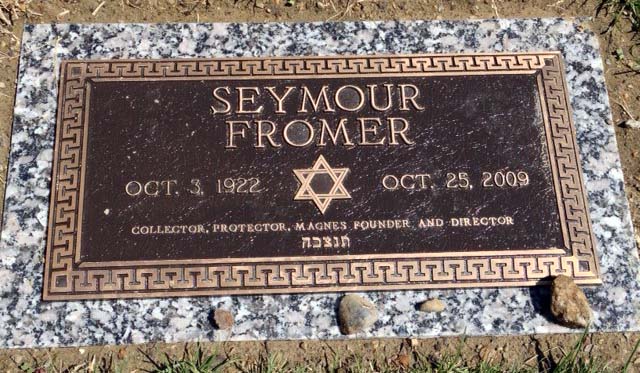
Collector, Protector, Magnes Founder and Director
I thought about what to say for all these long years—and now the deed is done. He's firmly fixed down under there. It's inescapable.
It wasn't just artifacts and manuscripts that he protected, although that's what he was known for. No, what he protected most of all was me. Seems more to the point than 'beloved father.'
And she's got closure too. I think she'd like what I finally came up with:

Teacher, Writer, Human Rights Fighter
These are the things that made her proud. Especially the 'fighter' part. Which is the part I always thought was unnecessary. But, well, whatever.
The point being—it finally does feel like closure. It really does. And she resisted it for so long when she was alive. Or maybe it was her anger he was gone. She herself had to wait one year as well—but that's expected. Within reason. He, on the other hand, was stoneless for four years.
I could feel him hovering, exploring, looking out for Judaica in the wee unlikely corners of the world. He was still out there on the hunt and prowl. And now, it's strange, he's not. Closure. He's happily ensconced. Just wishing that I'd bring him a pastrami sandwich from Saul's, heavy on the deli mustard.
They're in there. They're down there. They're under ground. They're quiet. Too quiet! Here's me. Up here. Still wanting to do them proud. Funny, I think about that now—making them proud—I never did before. Before. When they were alive, I did as I pleased. Studied what I wanted. Specialized in the not-usness that marks my chosen profession. But well, reprise: whatever. They like what I'm up to now.
Here's the weird thing. With closure, I seem to be able to write again. Though still the words are jerky, stiff and awkward. They don't flow. Watch them stumble across the line, almost embarrassed to take their places inside these clunky sentences. Oh well. At least it's writing. One word after another. A little rusty, sure. But real live actual words!
Is that what 'closure' does? Help us stumble on.
We wake up. And stretch. Clean the blech out of our eyes. Check ourselves out: Hmm. No broken bones, although the heart still aches. Is that what closure brings: Return to the land of the doing? Have we learned something yet? Are we a better person?
If so, I mean, well, this is America: Shouldn't there be a machine (or magic pill) that could do all this mourning for us quick and dirty? Help get us to the lessons of the closure side a helluva lot faster? Skip all that grief and pain, and go directly to 'just carry on'?
Or if no machine or pill has been invented, let's use the BigMac model. After all, we like to eat more than we like to labor.
I'll have my fries dipped in mourning sensitivity, (just not too much). A sprinkle empathy and sympathy, but only just a pinch. Gobble fast, greasy, and most of all, unthinking. Fast food for the bereaved. And then, you know, just let us rest in peace.
Will that work?
Monday, April 1, 2013
oba and oya have it out
I've never talked about Oba, not in public anyway. More, I whisper about her. Whisper to her. Whisper around her. Anything might offend. I try not to think about her too much. Living with her can be pure hell. But only sometimes. Here's the problem: her self-defeatism, if that is a word.
We had a conversation yesterday, 'conversation' being the polite word for it. She fucking cried, pouted, complained, and blamed (everybody else). Again.
"I'm all alone," she wailed, like I'm not right there next to her, as usual.
She then went on—you know the drill—nobody's helping her. Nobody's supporting her. Where's hers? I've heard this all before. Nobody's giving her a break, how 'bout a grant maybe, a really good job where you don't have to work. How 'bout free rent? Or no rent at all. How 'bout sex? Where's mine?
She cut off her ear, they say, to feed it to Chango.
You know, I just don't have much sympathy.
Oba could use a really good therapist, as far as I'm concerned.
She counters saying I don't understand her. Don't understand her pain. Her sense of humor. Her struggles. Her ambitions. How-hard-it-all-is for her in this world. She's absolutely right. She struggles like mad, and everything's a struggle. 'The world' just isn't taking care of her, and she's furious about that.
She's got to do it herself, and that just pisses her off. And she's sick of people telling her to pull herself up by the bootstraps and do it the fuck herself.
She raises her voice. She yells when she's not being just plain morose. She cut off her ear and fed it to Chango. (I mean, it didn't work too well for van Gogh either as a coping mechanism, but hell, at least he didn't stop painting).
Do you think that kind of behavior makes her more attractive? Do you think Chango was moved?
I'm not much of a supporter of woe-is-me strategies. I grew up hearing them, and I must say all it did was harden my soul. Make me want to never ever ask anyone for anything. Not long for anyone. And certainly not pine for them. I have no sense of 'deserving' or 'undeserving'. No sense of entitlement at all.
Expect nothing.
Be ready for anything.
Be prepared.
Maybe I'm a Boy Scout at heart.
It's not like Oba needs to pick up a sword to make her point. Granted, that's not her way. Just pick herself up. Dust herself off. Hold her head high. And get goddamn to work.
See what she's done? She's got me the fuck swearing.
Maybe I've got way too much of Weber's Protestant Ethic in me and not enough of Mauss's prestations. Or maybe I'm too selective in my sense of reciprocal obligations. Maybe I'm just a bitch with a sword. Maybe I'm supposed to fix her tight little universe for her. Find her a Chango and hand it to her on an ebony platter. Cut off my own ears and feed them to her so she can see I'm listening?
A good therapist is what she needs.
Maybe I should give her mine.
We had a conversation yesterday, 'conversation' being the polite word for it. She fucking cried, pouted, complained, and blamed (everybody else). Again.
"I'm all alone," she wailed, like I'm not right there next to her, as usual.
She then went on—you know the drill—nobody's helping her. Nobody's supporting her. Where's hers? I've heard this all before. Nobody's giving her a break, how 'bout a grant maybe, a really good job where you don't have to work. How 'bout free rent? Or no rent at all. How 'bout sex? Where's mine?
She cut off her ear, they say, to feed it to Chango.
You know, I just don't have much sympathy.
Oba could use a really good therapist, as far as I'm concerned.
She counters saying I don't understand her. Don't understand her pain. Her sense of humor. Her struggles. Her ambitions. How-hard-it-all-is for her in this world. She's absolutely right. She struggles like mad, and everything's a struggle. 'The world' just isn't taking care of her, and she's furious about that.
She's got to do it herself, and that just pisses her off. And she's sick of people telling her to pull herself up by the bootstraps and do it the fuck herself.
She raises her voice. She yells when she's not being just plain morose. She cut off her ear and fed it to Chango. (I mean, it didn't work too well for van Gogh either as a coping mechanism, but hell, at least he didn't stop painting).
Do you think that kind of behavior makes her more attractive? Do you think Chango was moved?
I'm not much of a supporter of woe-is-me strategies. I grew up hearing them, and I must say all it did was harden my soul. Make me want to never ever ask anyone for anything. Not long for anyone. And certainly not pine for them. I have no sense of 'deserving' or 'undeserving'. No sense of entitlement at all.
Expect nothing.
Be ready for anything.
Be prepared.
Maybe I'm a Boy Scout at heart.
It's not like Oba needs to pick up a sword to make her point. Granted, that's not her way. Just pick herself up. Dust herself off. Hold her head high. And get goddamn to work.
See what she's done? She's got me the fuck swearing.
Maybe I've got way too much of Weber's Protestant Ethic in me and not enough of Mauss's prestations. Or maybe I'm too selective in my sense of reciprocal obligations. Maybe I'm just a bitch with a sword. Maybe I'm supposed to fix her tight little universe for her. Find her a Chango and hand it to her on an ebony platter. Cut off my own ears and feed them to her so she can see I'm listening?
A good therapist is what she needs.
Maybe I should give her mine.
Monday, November 5, 2012
meetings with remarkable men
Actually, what I was after was a meeting with just one remarkable man. I had questions. He had answers. Not answers in the usual way, but he could expound, he could encourage. He could inspire. Influence. I could be bathed in his charisma. Be brought to tears by his wisdom. Stand in awe... Sit at his feet... You know the drill. Just your usual meetings with remarkable men.
I do have a rebbe who inspires in this way. And I heard him speak recently at a week long workshop at the Islamic Center in Oakland, California. Yup, he's that inspiring. You heard me right. The Islamic Center. This is what makes him so inspiring. The rabbi at the Islamic Center. It was also his birthday. He was turning 88.
He was more frail than I had ever seen him. He was aided by a tall Shaikh with an exotic name. There was even a zikhr in my rebbe's honor—an Islamic (Sufi, really) shared invocation of the Divine Name that can bring participants to trance, or tears, from the beauteous repetition of the holy name. For me, it brought me to both. Trance and tears. To be in the presence of this remarkable man. To think that I might not see him ever again. To realize that the zikhr still holds so much power over me. And in the flickering contemplation at the back of my mind (or perhaps my heart) of the long-felt secret desire to convert to Islam, if only for the purifying effect of the zikhr.
But the power of my rebbe was such, that there was no need for conversion. My rebbe himself practices zikhr. He himself is a Shaikh. A Sufi master. He practices something he calls multireligiousity, and advocates it mightily. Why limit yourself when there's so much out there in traditions not your own? I'm pretty ambivalent about such a position. My Native American friends think it's dangerous horseshit. And they're pretty vocal about it.
But the argument is valid. Why should we be limited by the narrowness of our own natal traditions, when others are so (or equally) powerful?
My rebbe's not talking about appreciation-of-the-Other. Not talking about acceptance or tolerance. Or visiting each other's holy places and houses of worship. Not talking about broad-based scholarship. Not talking about fieldwork among. No. He's talking about practice. About becoming. And holding all of it (yours, his, mine), holding all of it in the same thimble. Drinking all of the medicine down. Becoming. Being. Experiencing.
My little rebbe and the tall shaikh are on the same page in this regard. You should have heard the shaikh's yiddishisms! A miracle, indeed.
But that's not quite what I wanted to say here. What has brought me out of my long silence, after the death of my mother. Strange how her death brought me to a virtual paralysis of the fingertips. For almost a year, I have hardly been able to write a word. Strong mojo, that woman. I still don't understand it. I had so much to say, and it was just washed away in the shock of her departure.
No, what brought me back to my keyboard was waking up to a dream this morning. And thinking that it was still happening. That I was still there. It was one of those dreams. Hyper-real. How could it not have happened? It clobbered me. It shook me up. Wagged its finger at me in admonishment. It taught me a lesson. I'll show you, it said. You know. The usual dream stuff.
I needed to see Reb Zalman. I needed to confer with him about something urgent. It had to do with the Biblical Hebrew word את in the first lines of Genesis. It had to do with an important point in the film I'm making. Reb Zalman Schachter-Shalomi had been too frail and exhausted to meet with the many of us who had wanted individual consultations at the workshop. And I don't blame him. It's the nature of remarkable men that we pull at them, that we want their baraka (or their bracha)... We followers must be an exhausting lot. But he nodded graciously at me, his acknowledgement. A little twinkle in his eye. That in itself was precious, he was that holy in my mind.
But in the dream, I was given access. Here's the time. Here's the place. Here's the room number.
I took the elevator up to the 7th floor, and looked around. The Organization up there was all in the service of the rebbe. I was definitely in the right place, and so I wandered around. Read the literature. Waited. I'd come early, of course, hoping for more time. My questions were just that urgent.
After waiting my fair share, I went up to the Reception because I couldn't find the room.
"You're on the wrong floor," the neo-frummish woman told me. "He's in Room 6.1, which is not on 7."
I had gone to the wrong floor. Written the wrong number. Was in the wrong place. Was going to be late for my coveted and hard-won meeting.
I wasn't worthy, after all.
The elevator didn't stop on the 6th floor. That was a floor that required special access, and I seemed to have lost my privileges. The elevator no longer worked for me, although it would have earlier apparently.
I took the stairs.
The stairway door was miraculously slightly ajar. I was on the 6th floor at last.
And there, as I walked the hallway looking for 6.1—I saw every door somewhat ajar. And in every room sat a holy man or holy woman. Every different color. Bearded and unbearded. Gray haired and dark hair. Turbaned and veiled and uncovered. All. Waiting. Every door was open, every saint or shaikh or rebbe, every lama, every monk. Every insurgent rebel. Every learned practitioner. Every intuitive. Every tzaddik. Waiting there. All I had to do was walk through any door. Or all of them.
All, save 6.1. That one wasn't there at all.
I woke up this morning to a time change. I'm still not quite awake, really. Did time move forward or did it move backward? Or maybe it stopped entirely, and I don't have to teach my class. And what would I teach them, anyway?
There's this door, and there's that door I suppose. And, okay, yes—they're all more or less open. And what's strangest of all—is that my students most definitely walk through mine.
I do have a rebbe who inspires in this way. And I heard him speak recently at a week long workshop at the Islamic Center in Oakland, California. Yup, he's that inspiring. You heard me right. The Islamic Center. This is what makes him so inspiring. The rabbi at the Islamic Center. It was also his birthday. He was turning 88.
He was more frail than I had ever seen him. He was aided by a tall Shaikh with an exotic name. There was even a zikhr in my rebbe's honor—an Islamic (Sufi, really) shared invocation of the Divine Name that can bring participants to trance, or tears, from the beauteous repetition of the holy name. For me, it brought me to both. Trance and tears. To be in the presence of this remarkable man. To think that I might not see him ever again. To realize that the zikhr still holds so much power over me. And in the flickering contemplation at the back of my mind (or perhaps my heart) of the long-felt secret desire to convert to Islam, if only for the purifying effect of the zikhr.
But the power of my rebbe was such, that there was no need for conversion. My rebbe himself practices zikhr. He himself is a Shaikh. A Sufi master. He practices something he calls multireligiousity, and advocates it mightily. Why limit yourself when there's so much out there in traditions not your own? I'm pretty ambivalent about such a position. My Native American friends think it's dangerous horseshit. And they're pretty vocal about it.
But the argument is valid. Why should we be limited by the narrowness of our own natal traditions, when others are so (or equally) powerful?
My rebbe's not talking about appreciation-of-the-Other. Not talking about acceptance or tolerance. Or visiting each other's holy places and houses of worship. Not talking about broad-based scholarship. Not talking about fieldwork among. No. He's talking about practice. About becoming. And holding all of it (yours, his, mine), holding all of it in the same thimble. Drinking all of the medicine down. Becoming. Being. Experiencing.
My little rebbe and the tall shaikh are on the same page in this regard. You should have heard the shaikh's yiddishisms! A miracle, indeed.
But that's not quite what I wanted to say here. What has brought me out of my long silence, after the death of my mother. Strange how her death brought me to a virtual paralysis of the fingertips. For almost a year, I have hardly been able to write a word. Strong mojo, that woman. I still don't understand it. I had so much to say, and it was just washed away in the shock of her departure.
No, what brought me back to my keyboard was waking up to a dream this morning. And thinking that it was still happening. That I was still there. It was one of those dreams. Hyper-real. How could it not have happened? It clobbered me. It shook me up. Wagged its finger at me in admonishment. It taught me a lesson. I'll show you, it said. You know. The usual dream stuff.
I needed to see Reb Zalman. I needed to confer with him about something urgent. It had to do with the Biblical Hebrew word את in the first lines of Genesis. It had to do with an important point in the film I'm making. Reb Zalman Schachter-Shalomi had been too frail and exhausted to meet with the many of us who had wanted individual consultations at the workshop. And I don't blame him. It's the nature of remarkable men that we pull at them, that we want their baraka (or their bracha)... We followers must be an exhausting lot. But he nodded graciously at me, his acknowledgement. A little twinkle in his eye. That in itself was precious, he was that holy in my mind.
But in the dream, I was given access. Here's the time. Here's the place. Here's the room number.
I took the elevator up to the 7th floor, and looked around. The Organization up there was all in the service of the rebbe. I was definitely in the right place, and so I wandered around. Read the literature. Waited. I'd come early, of course, hoping for more time. My questions were just that urgent.
After waiting my fair share, I went up to the Reception because I couldn't find the room.
"You're on the wrong floor," the neo-frummish woman told me. "He's in Room 6.1, which is not on 7."
I had gone to the wrong floor. Written the wrong number. Was in the wrong place. Was going to be late for my coveted and hard-won meeting.
I wasn't worthy, after all.
The elevator didn't stop on the 6th floor. That was a floor that required special access, and I seemed to have lost my privileges. The elevator no longer worked for me, although it would have earlier apparently.
I took the stairs.
The stairway door was miraculously slightly ajar. I was on the 6th floor at last.
And there, as I walked the hallway looking for 6.1—I saw every door somewhat ajar. And in every room sat a holy man or holy woman. Every different color. Bearded and unbearded. Gray haired and dark hair. Turbaned and veiled and uncovered. All. Waiting. Every door was open, every saint or shaikh or rebbe, every lama, every monk. Every insurgent rebel. Every learned practitioner. Every intuitive. Every tzaddik. Waiting there. All I had to do was walk through any door. Or all of them.
All, save 6.1. That one wasn't there at all.
I woke up this morning to a time change. I'm still not quite awake, really. Did time move forward or did it move backward? Or maybe it stopped entirely, and I don't have to teach my class. And what would I teach them, anyway?
There's this door, and there's that door I suppose. And, okay, yes—they're all more or less open. And what's strangest of all—is that my students most definitely walk through mine.
Thursday, August 23, 2012
multireligiosity
Okay. I learned a new word. And I'm not sure what I think about it. In the past I've been downright incensed at the theft of indigenous spiritual practices by white wannabes. True, my outrage is for the most part borrowed. My indigenous friends just about foam at the mouth over this one. Especially when the appropriated song or ritual or practice is used by the wannabe at the wrong time, at the wrong place, and for the wrong purpose.
How can you, they inquire, take my song and abuse it this way? You took our land and our language. You stole our children and shipped them off to Christian boarding schools —and now you want our spirituality? Spiritual theft, indeed. I get it.
Remember the Cherokee elders who heckled Felicitas Goodman one year when we were all in Tempe, "The Creator made you a Presbyterian," they shouted. "Go back to church!"
My indigenous friends make the case for pure systems. Or for trying to keep them as pure as possible given that these 'systems' are by now long ago polluted with otherness, or almost completely wiped out anyway.
I understand the indigenous complaint. I'm sensitive to it. My own people are practically extinct as well. And I'd like to say that I don't beg, borrow, or steal from the traditions of others. Surely I don't practice anyone else's religion. I mean, I barely practice my own. No wonder it's dying out. So there should be nothing to complain about on that front. And I've learned to be super careful about not inviting guest lecturers to speak in my classes if they're folk who are immersed in someone else's tradition, no matter how knowledgeable or devout or sincere they may appear.
But then there's Zalman. Reb Zalman Schachter-Shalomi, my mentor. Reb Zalman, whose teachings helped me reconcile my love for Islamic cultures with holding on to my own unshakeable (nearly extinct) Sephardi identity. I had it all worked out at one point: I mean after all, it's because of the Ottoman Islamic State that my people survived at all. And before that, we thrived in Islamic Spain. It all sounds so rational when you put it like that. I mean, it's not like I wear a hijab (though I think they're pretty elegant), and I certainly don't perform Islamic prayers five times a day. No. I just appreciate Islam. It makes a lot of sense to me.
I hadn't seen Reb Zalman in many, many years, but here he was, giving a symposium for Star King at the Islamic Cultural Center in Oakland. Three days of Zalman!
And the service had everything in it.
Just name a religion, and it's tradition was in there somewhere. No pygmy chants that I recognized, but you get my point.
The word of the day was 'multireligiosity' —and the Star King folk, they practice what they preach. And it was pretty stunning. Each sentence was peppered with the weaving together of traditions. And so were the songs that were sung, and the gestures, and the clothing.
I want to call it syncretism, but it isn't. It's something more personal that that. For it seemed that every person in the hall had a different combination of religious affinities. And the lectures and sermons encouraged more of the same.
And to tell the truth, it was pretty neat to hear the Jewishisms coming out of the mouths of Muslims, and the Islamicisms falling out of the mouths of Jews. It wasn't forced, or enforced—it was merely comfort and familiarity with the Other. Or, no, not that—for Otherness had disappeared from their vocabulary. It was fairly seamless.
Reb Zalman spoke of the virtues of being in-between the strict adherences of the isms. He encouraged all to cultivate the larger tapestry. What kind of religion serves best the healing of the planet? Go and practice that.
It was three days of religious liminality. But it wasn't just about appreciating the Other, it was about practicing the practices of each. The symposium wasn't just merged wordings—there was ritual too. Performativity. And this is something I'm profoundly uncomfortable with. But Zalman encourages participation (and sure, it's part of anthropological methodology as well) (and so, deciding to be a good sport, and put my bloody notebook down and stop taking notes) I found myself in —
zikr
—crying my eyes out, as we chanted and bobbed. The rhythm is exactly the type that moves me, or maybe moves everybody. Look at films of zikr and you'll see just how entrancing it is. And it made me feel instead of making me think. Which is exactly what it's supposed to do. And exactly what Reb Zalman wants me to do. After all, he's a Jewfi.
Two zikrs in three days can bring on an addiction for sure. It's precisely the practice of religious ritual that is so powerful, not the intellectual appreciation of it. I'm still going to chalk it up to participant-observation, this time, at least. But deep down, I'm not so sure. I believe I'm in grave danger of wanting more.
And maybe of going out and finding it.
How can you, they inquire, take my song and abuse it this way? You took our land and our language. You stole our children and shipped them off to Christian boarding schools —and now you want our spirituality? Spiritual theft, indeed. I get it.
Remember the Cherokee elders who heckled Felicitas Goodman one year when we were all in Tempe, "The Creator made you a Presbyterian," they shouted. "Go back to church!"
My indigenous friends make the case for pure systems. Or for trying to keep them as pure as possible given that these 'systems' are by now long ago polluted with otherness, or almost completely wiped out anyway.
I understand the indigenous complaint. I'm sensitive to it. My own people are practically extinct as well. And I'd like to say that I don't beg, borrow, or steal from the traditions of others. Surely I don't practice anyone else's religion. I mean, I barely practice my own. No wonder it's dying out. So there should be nothing to complain about on that front. And I've learned to be super careful about not inviting guest lecturers to speak in my classes if they're folk who are immersed in someone else's tradition, no matter how knowledgeable or devout or sincere they may appear.
But then there's Zalman. Reb Zalman Schachter-Shalomi, my mentor. Reb Zalman, whose teachings helped me reconcile my love for Islamic cultures with holding on to my own unshakeable (nearly extinct) Sephardi identity. I had it all worked out at one point: I mean after all, it's because of the Ottoman Islamic State that my people survived at all. And before that, we thrived in Islamic Spain. It all sounds so rational when you put it like that. I mean, it's not like I wear a hijab (though I think they're pretty elegant), and I certainly don't perform Islamic prayers five times a day. No. I just appreciate Islam. It makes a lot of sense to me.
I hadn't seen Reb Zalman in many, many years, but here he was, giving a symposium for Star King at the Islamic Cultural Center in Oakland. Three days of Zalman!
And the service had everything in it.
Just name a religion, and it's tradition was in there somewhere. No pygmy chants that I recognized, but you get my point.
The word of the day was 'multireligiosity' —and the Star King folk, they practice what they preach. And it was pretty stunning. Each sentence was peppered with the weaving together of traditions. And so were the songs that were sung, and the gestures, and the clothing.
I want to call it syncretism, but it isn't. It's something more personal that that. For it seemed that every person in the hall had a different combination of religious affinities. And the lectures and sermons encouraged more of the same.
And to tell the truth, it was pretty neat to hear the Jewishisms coming out of the mouths of Muslims, and the Islamicisms falling out of the mouths of Jews. It wasn't forced, or enforced—it was merely comfort and familiarity with the Other. Or, no, not that—for Otherness had disappeared from their vocabulary. It was fairly seamless.
Reb Zalman spoke of the virtues of being in-between the strict adherences of the isms. He encouraged all to cultivate the larger tapestry. What kind of religion serves best the healing of the planet? Go and practice that.
It was three days of religious liminality. But it wasn't just about appreciating the Other, it was about practicing the practices of each. The symposium wasn't just merged wordings—there was ritual too. Performativity. And this is something I'm profoundly uncomfortable with. But Zalman encourages participation (and sure, it's part of anthropological methodology as well) (and so, deciding to be a good sport, and put my bloody notebook down and stop taking notes) I found myself in —
zikr
—crying my eyes out, as we chanted and bobbed. The rhythm is exactly the type that moves me, or maybe moves everybody. Look at films of zikr and you'll see just how entrancing it is. And it made me feel instead of making me think. Which is exactly what it's supposed to do. And exactly what Reb Zalman wants me to do. After all, he's a Jewfi.
Two zikrs in three days can bring on an addiction for sure. It's precisely the practice of religious ritual that is so powerful, not the intellectual appreciation of it. I'm still going to chalk it up to participant-observation, this time, at least. But deep down, I'm not so sure. I believe I'm in grave danger of wanting more.
And maybe of going out and finding it.
Monday, August 13, 2012
writing and seduction
"Have you written anything for me lately?"
School is starting in a week or two—and for the first time in my sentient life I won't be there to greet it. For me, school is finally, finally over.
But life is not as much fun without a little seduction now and then. Time to pick up that quill again, and try my rusty hand.
Well, no. Nothing at all.
So. What's the problem? And actually, I want to solve here a larger problem. The problem of bad writing altogether, especially that of undergrads. And maybe a few grad students as well. Or. To be honest. Maybe a lot of grad students.
And then I'll solve the teaching problem too. But not till the end of the post. Or next post, if I don't get around to it. But I think I will.
No. I haven't written anything for you lately. I've been too busy sleeping with you. Camping with you. Doing the being-together thing with you. I haven't written a goddamned word. Cooking. Doing the laundry. Emptying the trash. Muzzling the barky dog. Unmuzzling the quiet dog. Setting up the new computer to start writing. Clearing off the desk. Picking up the dogs shit. Working out, for god's sake!
Anything, anything at all but writing.
Which spells for me a stage of life that might be called 'post-seduction.'
It's that easy (still early enough) part of a relationship in which just picking up someone else's dog's shit is still kinda a kick enough to be fun. And done out of love and reciprocity (I pick up your dog shit, you pick up mine), and has not descended into resentment, or even worse—rage. Horrors. Don't get me wrong: it doesn't ever need to go that way. I think I like this stage of post-seduction. I like the mutuality of it. The minutiae of it. It's pretty easy. But I'm not sure it's quite enough.
Because writing is a powerful seduction.
I don't mean the kind of writing written explicitly in order to make a million bucks or two. I don't mean strategic writing. The porn of how he gets laid every X number of pages because you think that sells. That's not seduction. That's ambition. And I'm not talking about ambition.
The Story of O didn't make those big bucks because it was trying to seduce a large well-paying audience. Anne Desclos (Pauline Réage) had only an audience of one in mind. Everyone else has been just eavesdropping on a very private conversation.
And that's why it works.
And that's why it works.
The best writing has a sense of urgency as well as a very clear sense of audience.
Desclos knew what she was doing. As did Genet, when he sat in prison pleasuring himself with words. The stuff just pours out (the words, I mean—though with Genet, that would be both), because there's no way to dam the flow. Compelling writing is like that. And it doesn't have to reach everybody. It just has to reach that one person. The eavesdroppers come along for the ride. They're a freebie, if you will.
Desclos knew what she was doing. As did Genet, when he sat in prison pleasuring himself with words. The stuff just pours out (the words, I mean—though with Genet, that would be both), because there's no way to dam the flow. Compelling writing is like that. And it doesn't have to reach everybody. It just has to reach that one person. The eavesdroppers come along for the ride. They're a freebie, if you will.
Undergrads primarily write out of obligation. Coercion.
"How many pages do you want?" they ask in dismay.
They're not all like OMG, can you believe it, I GET to write something... I am so jazzed...
Think about it, students (if I may address you as such, just for a moment, one last time). When school is finally over, it is very likely that no one will ever give you the opportunity to take the time and just pour out your words ever again. For some of you, it's very likely you'll never ever write again. At least, that's what you've told me.
And you've forgotten, it seems, that someone has to read this crap you've flung at us as pages filled. Student papers have to be read (unlike that porn, the NYT, or any other written word). Someone has to read them. And that someone used to be me. But no, no more. With luck, I will never read another student paper ever again.
So. I'm gonna say this straight out (and with all due respect)—and I hope it helps. And maybe I should have said it in class. But no, you'd have taken it all wrong—
The best papers are a seduction.
They're written with words put together with that one specific 'audience' in mind. Beautiful combinations of words. Just for me, for you, whomever. A topic filled with three parts desire for every part called eloquent. Seduction trumps eloquence any day.
They're written with words put together with that one specific 'audience' in mind. Beautiful combinations of words. Just for me, for you, whomever. A topic filled with three parts desire for every part called eloquent. Seduction trumps eloquence any day.
It doesn't matter what the topic is.
Write about-the-economy-stupid. Write about Romney. Saddam (curious unconscious transition there). Write about whether to fund (or weaponize) Syrian rebels. Or how to get your name on a crater of Mars. Write about daffodils in the very early springtime. Drought mid-summer. What you had for breakfast this morning (and why we should care). Write about the gods. It's never ever about the subject anyway.
But if you're writing for that goddamned grade (or to make you that fortune you think is there)—you've missed the mark. You've got to be turned on by your own writing.
Seduce yourself, first and foremost, no matter the topic.
There's a flush, a blush in those students who fall in love with their own work. Their cheeks blossom, their eyes twinkle. They're not being strategic, they're being excited by the material at hand.
I haven't written for you lately.
I've been too busy doing anything but writing.
Because my own writings were missives to death, love songs to the dead and dying. Remembrances, lest I forget. Tales to my children, lest they never have the opportunity to remember. Stories that will be forever gone if I don't write them down. No one else can do it.
In the face of death and dying, I seduce myself with words. Genet was ever my best teacher.
Ah, but here's the rub. Let me not put this all upon the student who writes because he feels he's forced. Because the-system's telling him to jump through hoops, crank out those pages. Because he's stuck with an English class (or god-forbid, Anthropology) and he's an Engineering student. And shit, I have to in order to-get-outta-here. Goddamn it, when they resent their being in school, it drives me mad!
This goes for teachers, too, you know.
This goes for teachers, too, you know.
Teaching is seduction, too.
A prominent psychoanalyst told me that one time when I complained to him of such.
Not a seduction of the person, but of the material at hand. If you as you lecture are in love with your topic, that is the best seduction of all. (In truth, that's not quite what he said. To an analyst, it's all about the person).
Topic doesn't matter. Ancient Greek or Pleistocene dentition. The fall of the Ottoman Empire. Black holes. Who cares? It's all seduction-worthy.
Blow on those embers and makes them glow.
I've been doing laundry, not writing. Cooking for you. And eating your own exotic meals. Camping out, and hiking trails. Studying pig roasts and fishin' holes. Walking dogs and bagging dog shit together. I've been doing chop wood, carry water of late. Pouring out a simple kind of love and not seduction.
In other words, I started just to live again. And started leaving all those stories far behind.
School is starting in a week or two—and for the first time in my sentient life I won't be there to greet it. For me, school is finally, finally over.
But life is not as much fun without a little seduction now and then. Time to pick up that quill again, and try my rusty hand.
Saturday, July 7, 2012
aliens ... with guns (for real)
Ok. So I'm sitting here with the girlfriend and we're talking about camping with her parents in Montana. And I'm like, fine, I can't wait. That's good. Haven't been camping since last summer, and I can't wait, and we're all equipment-ed up, because we're both camping-equipment whores. So. we're all set. And I've cleared it with my Chair: he says it's ok to quit my job after I get back instead of before. He's a good boss. (Actually, there's no way I can clear out my office before then anyway. Just want you to know I'm not a shirker or anything).
So. Everybody's schedule finally fits. Except the girlfriend's kitties need a good sitter. But surely that'll work out. Right?
So. We're going. Or rather, we're talking about going. And I've never been to Montana. But I hear it's beautiful and somewhat wild.
And she says that when camping with her folks each person makes a meal. And she tells me what I should make. And I think, you're joking, right? Sephardi food isn't for camping. But whatever, it's my default setting, and if they like my yaprakas maybe they'll like me too. Okay. I can do that. And we'll haul the ingredients all the way from California. And she says I should make my grandpa's— well, it's a secret. But I'm not sure you can get Bulgarian feta while camping in Montana, so that's gotta be packed up too.
I wanted them to come to us. Big Sur. Pfieffer Beach. You know the drill. One of the most beautiful places in the world that's close by and drop dead gorgeous.
But there's nothing to kill around there.
Huh?
There's nothing to kill, and the timing I suggested was just right for killing pheasants and maybe grouse or some kinda upland bird season, something like that.
And I thought, well shit. Every lunar cycle of the year has something to kill if you're an outdoorsman.
And the girlfriend says, I can't wait until you have this conversation with my dad when we're camping.
And I say, well no the fuck way.
Because there's an argument to be made for being able to hunt and fish your food all year round. And I admire it. It's one of those post-apocalyptic skills that I wish I had, but don't.
Right this minute, the girlfriend is firing up the smoker and filleting this enormous (wild) salmon. Great for the Atkins diet. That's what Californians say.
But here's the sad part. We bought this beautiful salmon at the fish market in well-appointed yuppy Montclair 'Village.' (I'm not sure when Montclair became a quaint village. When I was a kid, it was just rich, not adorable).
And now I'm feeling guilty about purchased meat, when there's a killer in the family who can supply the needs of a rather large extended family all year round, right?
This is not how I grew up.
You want meat?
You call the kosher butcher.
And he sends the butcher's son around to deliver the lox or brisket to your house so that the son can catch your daughter's eye, and maybe there's a shittach down the road.
That's kosher meat for you.
My father, the tzaddik, never killed anything in his life. And while Mrs Tzaddik was good at throwing things, she never killed anything either. Or certainly not something you could eat.
I think this is all the reason I tried to be a vegetarian. But then there's Atkins. And you'd end up living on eggs and cheese pretty much.
I've decided I'm ok with all the killing, when accompanied by eating. And I'm in awe of the skills required.
But once, just once, I'm hoping there's an off season for everything on earth that can be shot or fished or snared or whatever. And that I can get the girlfriend's parents camping California style. In my beautiful Big Sur, with a stride down Pfeiffer Beach, with nothing, nothing for miles around to kill but time.
So. Everybody's schedule finally fits. Except the girlfriend's kitties need a good sitter. But surely that'll work out. Right?
So. We're going. Or rather, we're talking about going. And I've never been to Montana. But I hear it's beautiful and somewhat wild.
And she says that when camping with her folks each person makes a meal. And she tells me what I should make. And I think, you're joking, right? Sephardi food isn't for camping. But whatever, it's my default setting, and if they like my yaprakas maybe they'll like me too. Okay. I can do that. And we'll haul the ingredients all the way from California. And she says I should make my grandpa's— well, it's a secret. But I'm not sure you can get Bulgarian feta while camping in Montana, so that's gotta be packed up too.
I wanted them to come to us. Big Sur. Pfieffer Beach. You know the drill. One of the most beautiful places in the world that's close by and drop dead gorgeous.
But there's nothing to kill around there.
Huh?
There's nothing to kill, and the timing I suggested was just right for killing pheasants and maybe grouse or some kinda upland bird season, something like that.
And I thought, well shit. Every lunar cycle of the year has something to kill if you're an outdoorsman.
And the girlfriend says, I can't wait until you have this conversation with my dad when we're camping.
And I say, well no the fuck way.
Because there's an argument to be made for being able to hunt and fish your food all year round. And I admire it. It's one of those post-apocalyptic skills that I wish I had, but don't.
Right this minute, the girlfriend is firing up the smoker and filleting this enormous (wild) salmon. Great for the Atkins diet. That's what Californians say.
But here's the sad part. We bought this beautiful salmon at the fish market in well-appointed yuppy Montclair 'Village.' (I'm not sure when Montclair became a quaint village. When I was a kid, it was just rich, not adorable).
And now I'm feeling guilty about purchased meat, when there's a killer in the family who can supply the needs of a rather large extended family all year round, right?
This is not how I grew up.
You want meat?
You call the kosher butcher.
And he sends the butcher's son around to deliver the lox or brisket to your house so that the son can catch your daughter's eye, and maybe there's a shittach down the road.
That's kosher meat for you.
My father, the tzaddik, never killed anything in his life. And while Mrs Tzaddik was good at throwing things, she never killed anything either. Or certainly not something you could eat.
I think this is all the reason I tried to be a vegetarian. But then there's Atkins. And you'd end up living on eggs and cheese pretty much.
I've decided I'm ok with all the killing, when accompanied by eating. And I'm in awe of the skills required.
But once, just once, I'm hoping there's an off season for everything on earth that can be shot or fished or snared or whatever. And that I can get the girlfriend's parents camping California style. In my beautiful Big Sur, with a stride down Pfeiffer Beach, with nothing, nothing for miles around to kill but time.
Tuesday, July 3, 2012
ten signs of life, in no particular order
I'm still paying her bills.
She's still telling me what to do.
I've still got lemons from her tree.
Her mail keeps coming (then again, so does his).
There're fragments of poems in her notebook that she's clearly still working on.
Her friends still call and some come over.
I see her, especially at the opera.
She still gives wild and sometimes lavish gifts.
The Sunday NYT is on the doorstep with alarming regularity.
There's no stone or plaque or any other sign of her departure.
She's still telling me what to do.
I've still got lemons from her tree.
Her mail keeps coming (then again, so does his).
There're fragments of poems in her notebook that she's clearly still working on.
Her friends still call and some come over.
I see her, especially at the opera.
She still gives wild and sometimes lavish gifts.
The Sunday NYT is on the doorstep with alarming regularity.
There's no stone or plaque or any other sign of her departure.
Monday, June 25, 2012
ding dong the witch is dead —
Ding dong the witch is dead — and Malkah cried some, but mostly was in shock. Malkah was sure she'd live forever, in her witchy way, casting evil spells to disable opponents and take your breath clean away. Her magic was formidable.
If you told her about a new girlfriend, finally one you'd thought she'd finally approve, she glared and gave her curse:
You'll only hurt her.
And from her mouth to God's ear, that would become the truth.
If she asked you, well, when she's dead do you promise to live in the house and keep it exactly as is, everything in its place? And you're evasive, and talk about how beautiful the dome of the Great Room would be with the ancient Egyptian goddess Nuit painted across the ceiling along with deep blue sky and gold and silver stars — she'd respond with her signature,
I'll curse you from the grave.
Scary shit. Because when she said it, it sounded really real. Not something you could laugh at. Not something she'd smile about afterwards. More like you better duck right now because the sky is falling. Or it will be soon.
She liked to assert preemptive control from the afterlife a lot in those days.
But then, something strange happened as she lay dying for a few years.
She got nicer. Supportive. Still scary. But scary helpful, instead of scary scary. She insisted on helping. On being there for you. On healing you. On telling you how to heal, like you had no idea how to take care of yourself.
Imperious never went away.
Demanding. Penetrating. Glaring. Regally holding court from her hospital bed. Looking all the queen of heaven and earth. She glowed as she reigned. She captured and she captivated. And she still cursed, of course. You don't give up power like that so easily, right?
But she softened. Or rather, she let her soft side show. Well, maybe not to everyone, but at least to Malkah, who was shocked beyond words. She gave Malkah compliments.
Who knew you could be so competent? she'd say.
I can't believe you're still here taking care of me! She'd say. Expecting her daughter to up and go poof any second now.
In truth, she had cause not to expect Malkah's care for her at all. How many of the hired help had up and fled in tears after her rebuke and wildfire rage? And these were trained professionals, or well, some of them were, with experience of the abuses the elderly can mete out on others.
Ah, that wicked wicked tongue! She was so proud of it. She boasted of it. Repeated to Malkah over and over some nasty thing she'd said to some good friend or other. And Malkah always wondered why those folks they stuck around.
She loved cursing them. In writing, especially. How many people have kept copies of her loquacious and lengthy curses? She was a poet after all. She had a well-oiled facility with words.
Abra-ca-dabra. I create as I speak. Just like God, the poet uses words to bring evil and good into the world. Which is why it's good idea to keep your mouth shut no matter what just in case you can't tell the difference.
I was silent. For months on end, I could not write nor speak a word. I was stunned at her departure. Yes, I put my shovel full of dirt upon her grave, as did we all, still expecting her to rise once more. To direct me. Forbid me. Coerce me. Condemn me. Demand of me. And to critique my posture, when she just couldn't think of anything else to say.
And then suddenly she was nice. Just like that.
It wasn't her seductive nice that she saved for handsome men. No, it was the nice that comes from just plain letting go of forcing the world into her mold, her blueprint and requisite dimensions.
Well, okay, I overspoke. Suddenly she was nice to Malkah at least.
I wonder if this is what Confession is for in religious traditions not my own. Does letting go bring purity or relief? Especially at the end of life? I have no idea. But she let go. She cut the umbilicus that tethered Malkah to her rages.
I'm left here with an emptiness, a dearth of evil. It seems to be entirely gone inside my being. No curses from the grave (not even mild admonitions) press down upon my shoulders. The world feels emptier now. And emptiness became a theme upon her exit from her gilded stage.
I emptied out her house and gave away or sold her things. I took the orphaned plants into my garden and watched them up and bloom. I got a lot of help dismantling her universe. The emptiness feels almost Buddhist in its peaceful glory.
Malkah sold her house to a family of Egyptians.
I'm hoping they'll paint the ancient goddess Nuit upon the dome of that extraordinary Great Room. With deep blue skies and gold and silver stars twinkling from above the vaulted hall. Bringing peace on earth, of course, and good will to absolutely all.
If you told her about a new girlfriend, finally one you'd thought she'd finally approve, she glared and gave her curse:
You'll only hurt her.
And from her mouth to God's ear, that would become the truth.
If she asked you, well, when she's dead do you promise to live in the house and keep it exactly as is, everything in its place? And you're evasive, and talk about how beautiful the dome of the Great Room would be with the ancient Egyptian goddess Nuit painted across the ceiling along with deep blue sky and gold and silver stars — she'd respond with her signature,
I'll curse you from the grave.
Scary shit. Because when she said it, it sounded really real. Not something you could laugh at. Not something she'd smile about afterwards. More like you better duck right now because the sky is falling. Or it will be soon.
She liked to assert preemptive control from the afterlife a lot in those days.
But then, something strange happened as she lay dying for a few years.
She got nicer. Supportive. Still scary. But scary helpful, instead of scary scary. She insisted on helping. On being there for you. On healing you. On telling you how to heal, like you had no idea how to take care of yourself.
Imperious never went away.
Demanding. Penetrating. Glaring. Regally holding court from her hospital bed. Looking all the queen of heaven and earth. She glowed as she reigned. She captured and she captivated. And she still cursed, of course. You don't give up power like that so easily, right?
But she softened. Or rather, she let her soft side show. Well, maybe not to everyone, but at least to Malkah, who was shocked beyond words. She gave Malkah compliments.
Who knew you could be so competent? she'd say.
I can't believe you're still here taking care of me! She'd say. Expecting her daughter to up and go poof any second now.
In truth, she had cause not to expect Malkah's care for her at all. How many of the hired help had up and fled in tears after her rebuke and wildfire rage? And these were trained professionals, or well, some of them were, with experience of the abuses the elderly can mete out on others.
Ah, that wicked wicked tongue! She was so proud of it. She boasted of it. Repeated to Malkah over and over some nasty thing she'd said to some good friend or other. And Malkah always wondered why those folks they stuck around.
She loved cursing them. In writing, especially. How many people have kept copies of her loquacious and lengthy curses? She was a poet after all. She had a well-oiled facility with words.
Abra-ca-dabra. I create as I speak. Just like God, the poet uses words to bring evil and good into the world. Which is why it's good idea to keep your mouth shut no matter what just in case you can't tell the difference.
I was silent. For months on end, I could not write nor speak a word. I was stunned at her departure. Yes, I put my shovel full of dirt upon her grave, as did we all, still expecting her to rise once more. To direct me. Forbid me. Coerce me. Condemn me. Demand of me. And to critique my posture, when she just couldn't think of anything else to say.
And then suddenly she was nice. Just like that.
It wasn't her seductive nice that she saved for handsome men. No, it was the nice that comes from just plain letting go of forcing the world into her mold, her blueprint and requisite dimensions.
Well, okay, I overspoke. Suddenly she was nice to Malkah at least.
I wonder if this is what Confession is for in religious traditions not my own. Does letting go bring purity or relief? Especially at the end of life? I have no idea. But she let go. She cut the umbilicus that tethered Malkah to her rages.
I'm left here with an emptiness, a dearth of evil. It seems to be entirely gone inside my being. No curses from the grave (not even mild admonitions) press down upon my shoulders. The world feels emptier now. And emptiness became a theme upon her exit from her gilded stage.
I emptied out her house and gave away or sold her things. I took the orphaned plants into my garden and watched them up and bloom. I got a lot of help dismantling her universe. The emptiness feels almost Buddhist in its peaceful glory.
Malkah sold her house to a family of Egyptians.
I'm hoping they'll paint the ancient goddess Nuit upon the dome of that extraordinary Great Room. With deep blue skies and gold and silver stars twinkling from above the vaulted hall. Bringing peace on earth, of course, and good will to absolutely all.
Subscribe to:
Posts (Atom)
